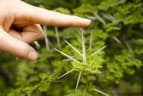
Vachellia erioloba
Vachellia erioloba
Safety & Hazards
The prussic acid that is sometimes present in the pods and foliage may poison animals[1].
Cultivation Details
Camel thorn grows in tropical and subtropical areas at elevations of 200 - 1,200 metres[1]. Tolerant of some frost, it grows best in areas with a mean annual temperature in the range 12 - 29c and a mean annual rainfall of 250 - 1,000mm[1]. Prefers a well-drained, sandy, acidic soil[1]. Young plants require large amounts of light[1]. Established plants are drought resistant[1]. A very deep-rooting plant - some plants have been reported with roots descending to a depth of 45 metres in a borehole in SW. Africa[2]. This species is valued throughout its range for its products and services and is rarely the subject of eradication measures[1]. This species hybridizes in the wild with Vachellia haematoxylon, and the resulting progeny looks extremely similar to Vachellia erioloba but has glands on the pods typical of Vachellia haematoxylon[1]. Trees usually flower when about 10 years old, and by 20 years they can produce regular crops of large pods[1]. Natural and artificial regeneration from seed is poor, even after presowing treatment, but the trees coppice and sucker fairly readily[1]. Fire causes young trees to coppice[1]. This species has a symbiotic relationship with certain soil bacteria, these bacteria form nodules on the roots and fix atmospheric nitrogen. Some of this nitrogen is utilized by the growing plant but some can also be used by other plants growing nearby[3].
Propagation
Seed - pre-soak for 12 hours in warm water prior to sowing. Scarification can also help to improve germination rates. Germination rates are often poor for this species, but they can be improved by planting seeds (together with the dung) that have passed through the guts of grazing animals[1]. This is because bruchid larvae that normally infest seeds are usually killed during their passage through the gut of a herbivore[1]. It is best to sow the seeds singly in containers and transplanted the seedlings as quickly as possible since the taproot develops rapidly[1]. Seedlings should be planted out when 46 cm or more in height and should be watered for the first few months, after which they become drought resistant[1]. Seeds retain their viability for many years even at room temperature. Bruchid larvae within the seed continue to be active after the seed has been extracted and stored. The adults or larvae of some species emerge and may even re-enter the exit holes to lay eggs or to produce a 2nd generation of larvae that feed on the seed. Storage at temperatures near freezing point reduces bruchid beetle activity, and subzero temperatures of -20-30 deg. C may kill the larvae without damaging the seed[1]. Cite as: Tropical Plants Database, Ken Fern. tropical.theferns.info. 2026-02-20. <tropical.theferns.info/viewtropical.php?id=Vachellia+erioloba>
Pollinators
Bees
References
- [1]World Agroforesty Centre — http://www.worldagroforestry.org/ ↩︎An excellent online database of a huge range of trees giving very good information on each plant - its uses, ecology, identity, propagation, pests etc.
- [2]Flora Zambesiaca — http://apps.kew.org/efloras/fz/intro.html ↩︎An excellent online flora of plants from the Zambezi River basin. It lists a number of the plant uses as well as the habitats and botanical descriptions of the plants.
- [3]The New RHS Dictionary of Gardening. 1992. — Huxley. A. · MacMillan Press · 1992 · ISBN 0-333-47494-5 ↩︎Excellent and very comprehensive, though it contains a number of silly mistakes. Readable yet also very detailed.
- [4]Cornucopia II — Facciola. S. · Kampong Publications, California. · 1998 · ISBN 0-9628087-2-5 ↩︎The second edition of an excellent guide to the edible uses of plants, though it does not give any details of cultivation etc.
- [5]Flora and Fauna of Africa — http://www.gateway-africa.com/fuanaflora/index.html ↩︎Contains photos and basic information on the plant and its uses. So far just over 70 species appear on the site, though they say that it is a work in progress.
- [6]Trees and Shrubs of the Okavango Delta; Medicinal Uses and Nutritional Value — Roodt V. · Shell Oil Botswana (Pty) Ltd; Gaborone, Botswana · 1998 · ISBN 99912-0-241-2 ↩︎A concise guide to some of the trees and shrubs of Botswana, often giving some of the plant's uses.
- [7]Dictionary of Economic Plants. — Uphof. J. C. Th. · Weinheim · 1959 · ISBN - ↩︎An excellent and very comprehensive guide but it only gives very short descriptions of the uses without any details of how to utilize the plants. Not for the casual reader.
- [8]Gemsbok Bean and Kalahari Truffle — Leffers A. · Gamsberg MacMillan; Namibia. · 2003 · ISBN 99916-0-491-X ↩︎Details of the traditional uses of over 200 species of plants in northeastern Namibia. Written for the non-expert, there is usually at least one photograph with each plant entry.