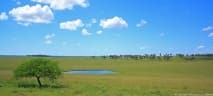
Vachellia caven
Vachellia caven
Safety & Hazards
None known
Cultivation Details
Succeeds in warm temperate to subtropical and tropical areas. It is found at low to moderate elevations in Chile, in dry to moist regions where the annual rainfall is in the range of 100 - 800mm and there is a distinct dry season that can be as long as 10 months[1]. Plants can withstand light frosts, but do not tolerate temperatures much below freezing[1]. The plant is recommended for desert or semi-arid conditions, but it is very adaptable and grows successfully in the much moister climate of Kew Gardens in southern England[2]. Prefers a well-drained, circumneutral to slightly acid soil and a position in full sun[3, 4]. Prefers an acid soil with a significant content of organic matter[1]. Established plants are drought tolerant[4]. A fairly fast-growing plant, able to reach a height of 2 metres within two years from seed[1]. The deep-yellow flowers are produced in great abundance and are very fragrant, scenting the air around the tree[4, 2]. This species has a symbiotic relationship with certain soil bacteria, these bacteria form nodules on the roots and fix atmospheric nitrogen. Some of this nitrogen is utilized by the growing plant but some can also be used by other plants growing nearby[5].
Propagation
Seed - best sown as soon as it is ripe in a sunny position in a warm greenhouse[6]. Stored seed should be scarified, pre-soaked for 12 hours in warm water and then sown in a warm greenhouse in early spring. The seed germinates in 3 - 4 weeks at 25°c[7]. As soon as the seedlings are large enough to handle, prick them out into individual pots and grow them on in a sunny position in the greenhouse for their first winter. Plant them out in late spring or early summer, after the last expected frosts, and consider giving them some protection from the cold for their first winter outdoors. Cuttings of half-ripe wood with a heel, mid summer in individual pots in a frame[8]. Overwinter in a greenhouse for the first winter and plant out in their permanent positions in late spring or early summer. Fair percentage[8]. Cite as: Temperate Plants Database, Ken Fern. temperate.theferns.info. 2026-02-21. <temperate.theferns.info/plant/Vachellia+caven>
Pollinators
Insects
References
- [1]ChileFlora — http://www.chileflora.com/index.html ↩︎Not realy a flora, but a lovely site with lots of helpful information for the gardener and an abundance of excellent photos covering over 2,000 species of Chilean plants.
- [2]New Trees — Grimshaw J.; Bayton R.; Wilks H. · Kew Publishing; London · 2009 · ISBN 1842461737 ↩︎Provides comprehensive botanical descriptions and horticultural commentary on over 800 tree species that have been introduced to cultivation in recent decades.
- [3]The New RHS Dictionary of Gardening. 1992. — Huxley. A. · MacMillan Press · 1992 · ISBN 0-333-47494-5 ↩︎Excellent and very comprehensive, though it contains a number of silly mistakes. Readable yet also very detailed.
- [4]Brazilian Trees. Volume 3. — Lorenzi. H. · Instituto Plantarum De Estudos Da Flora; Brazil. · 2009 · ISBN 85-86714-34-4 ↩︎Information on 350 species of Brazilian trees. Stunning photographs of each species, brief details on the plant, its uses and how to grow it from seed. A superb work, with the minor irritation that the translation from Portuguese is not of the best.
- [5]Nodulation Plants in GRIN Taxonomy — United States Department of Agriculture · http://www.ars-grin.gov/~sbmljw/cgi-bin/taxnodul.pl?language=en ↩︎An online database listing plants that have either positive or negative reports on root and stem nodulation with nitrogen-fixing bacteria.
- [6]RHS Dictionary of Plants plus Supplement. 1956 — F. Chittendon. · Oxford University Press · 1951 · ISBN - ↩︎Comprehensive listing of species and how to grow them. Somewhat outdated, it has been replaced in 1992 by a new dictionary (see [ 200 ]).
- [7]Growing from Seed. Volume 1. — Rice. G. (Editor) · Thompson and Morgan. · 1987 · ISBN - ↩︎Very readable magazine with lots of information on propagation.
- [8]Propagation of Trees, Shrubs and Conifers. — Sheat. W. G. · MacMillan and Co · 1948 · ISBN - ↩︎A bit dated but a good book on propagation techniques with specific details for a wide range of plants.
- [9]Dictionary of Economic Plants. — Uphof. J. C. Th. · Weinheim · 1959 · ISBN - ↩︎An excellent and very comprehensive guide but it only gives very short descriptions of the uses without any details of how to utilize the plants. Not for the casual reader.
- [10]The Useful Native Plants of Australia. — Maiden J.H. · Turner & Co.; London. · 1889 · http://www.biodiversitylibrary.org ↩︎Terse details of the uses of many Australian plants and other species naturalised, or at least growing, in Australia. It can be downloaded from the Internet.
- [11]Mansfeld's Database of Agricultural and Horticultural Plants — http://mansfeld.ipk-gatersleben.de/pls/htmldb_pgrc/f?p=185:3:4292127278597336 ↩︎Terse details of a huge range of useful plants.
- [PFAF]Plants for a Future — pfaf.org ↩︎