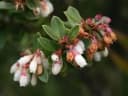
Vaccinium floribundum
Vaccinium floribundum
Safety & Hazards
None known
Cultivation Details
Vaccinium floribundum succeeds outdoors only in the milder areas of the temperate zone, where it can grow well in a woodland garden[1, 2] .Although frosts can occur on almost any night at the higher elevations of its native range, the plant still grows and crops well there. The daytimes there, however, are generally warm or hot all year round, and so it is the longer lasting cold of winters in the temperate zone that causes damage to the plant. Succeeds in full sun or light shade though it fruits better in a sunny position[3]. Requires a moist but freely-draining lime free soil, preferring one that is rich in peat or a light loamy soil with added leaf-mould[4, 3]. Prefers a very acid soil with a pH in the range of 4.5 to 6, plants soon become chlorotic when lime is present. Requires shelter from strong winds[3]. Seemingly fire resistant, the plant often sprouts vigorously after fire[5]. Dislikes root disturbance, plants are best grown in pots until being planted out in their permanent positions[3]. Plants in this genus are notably resistant to honey fungus[3].
Propagation
Seed - sow late winter in a greenhouse in a lime-free potting mix and only just cover the seed[6]. Stored seed might require a period of up to 3 months cold stratification[7]. Another report says that it is best to sow the seed in a greenhouse as soon as it is ripe[3]. Once they are about 5cm tall, prick the seedlings out into individual pots and grow them on in a lightly shaded position in the greenhouse for at least their first winter. Plant them out into their permanent positions in late spring or early summer, after the last expected frosts. Cuttings of half-ripe wood, 5 - 8cm with a heel, August in a frame[6]. Slow and difficult. Layering in late summer or early autumn[6]. Another report says that spring is the best time to layer[3]. Takes 18 months[6]. Division of suckers in spring or early autumn[7]. Cite as: Temperate Plants Database, Ken Fern. temperate.theferns.info. 2026-02-21. <temperate.theferns.info/plant/Vaccinium+floribundum>
Pollinators
Insects
References
- [1]The Milder Garden. — Taylor. J. · Dent · 1990 ↩︎A good book on plants that you didn't know could be grown outdoors in Britain.
- [2]Ornamental Shrubs, Climbers and Bamboos. — Thomas. G. S. · Murray · 1992 · ISBN 0-7195-5043-2 ↩︎Contains a wide range of plants with a brief description, mainly of their ornamental value but also usually of cultivation details and varieties.
- [3]The New RHS Dictionary of Gardening. 1992. — Huxley. A. · MacMillan Press · 1992 · ISBN 0-333-47494-5 ↩︎Excellent and very comprehensive, though it contains a number of silly mistakes. Readable yet also very detailed.
- [4]Trees and Shrubs Hardy in Great Britain. Vol 1 - 4 and Supplement. — Bean. W. · Murray · 1981 · ISBN - ↩︎A classic with a wealth of information on the plants, but poor on pictures.
- [5]Neotropical Blueberries - The Plant Family Ericaceae — Luteyn. J.L. & Pedraza-Peñalosa. P. · http://www.nybg.org/bsci/res/lut2/ ↩︎A very comprehensive on-line guide to the Ericaceae of tropical America, giving full botanical descriptions, often with details of plant uses.
- [6]Propagation of Trees, Shrubs and Conifers. — Sheat. W. G. · MacMillan and Co · 1948 · ISBN - ↩︎A bit dated but a good book on propagation techniques with specific details for a wide range of plants.
- [7]The Reference Manual of Woody Plant Propagation. — Dirr. M. A. and Heuser. M. W. · Athens Ga. Varsity Press · 1987 · ISBN 0942375009 ↩︎A very detailed book on propagating trees. Not for the casual reader.
- [8]Dictionary of Economic Plants. — Uphof. J. C. Th. · Weinheim · 1959 · ISBN - ↩︎An excellent and very comprehensive guide but it only gives very short descriptions of the uses without any details of how to utilize the plants. Not for the casual reader.
- [9]Cornucopia - A Source Book of Edible Plants. — Facciola. S. · Kampong Publications · 1990 · ISBN 0-9628087-0-9 ↩︎Excellent. Contains a very wide range of conventional and unconventional food plants (including tropical) and where they can be obtained (mainly N. American nurseries but also research institutes and a lot of other nurseries from around the world.
- [10]Lost Crops of the Incas — Popenoe. H. et al · National Academy Press · 1990 · ISBN 0-309-04264-X ↩︎An excellent book. Very readable, with lots of information and good pictures of some lesser known food plants of S. America.
- [11]Tanaka's Cyclopedia of Edible Plants of the World. — Tanaka. T. & Nakao S. · Keigaku Publishing; Tokyo · 1976 · ISBN - ↩︎The most comprehensive list of edible plants I've come across. Only the briefest entry for each species, though, and some of the entries are more than a little dubious. Not for the casual reader.