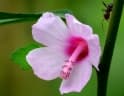
Urena lobata
Urena lobata
Safety & Hazards
None known
Cultivation Details
The plant has spread widely as a weed throughout the wet to semi-arid tropics and into the subtropics. It is sometimes cultivated as an annual in cooler climates[1]. It grows best in areas where the mean maximum and minimum annual temperatures are within the range 21 - 27°c, though it can tolerate 18 - 32°c[1]. It prefers a mean annual rainfall of 700 - 1,200mm, but tolerates 550 - 4,300mm[1]. Requires a sunny position[1]. Prefers humus rich, medium-textured soils but can succeed in a range of conditions as long as the soil is well-drained[1]. Prefers a pH in the range 5.5 - 6.5, tolerating 4.5 - 8[1]. The seed capsules, which are covered in hairs that stick to clothing and fur, can be carried some distance from the plant and thus the plant spreads into new areas[2, PFAF]. It has become an invasive weed in many areas[3]. A short-day plant, flowering starts 4 - 6 months after sowing, depending on the sowing time, while most viable seed is produced 1 - 2 months after flowering[2]. Production of green plants may be about 40 t/ha, yielding about 2 - 3 t/ha of dry retted fibre[1]. The flowers open early in the morning and wither about noon[2].
Propagation
Seed - germination rates and time are much improved if the seed is scarified prior to sowing[2]. Cite as: Tropical Plants Database, Ken Fern. tropical.theferns.info. 2026-02-20. <tropical.theferns.info/viewtropical.php?id=Urena+lobata>
Pollinators
Ants, Aphids, Hymenoptera
References
- [1]Ecocrop — http://ecocrop.fao.org/ecocrop/srv/en/home ↩︎Basic information on a wide range of useful plants, plus details of environmental needs where available.
- [2]Plant Resources of Southeast Asia — http://proseanet.org/ ↩︎Lots of information on the uses of the plants of SE Asia.
- [3]Pacific Island Ecosystems at Risk — http://www.hear.org/pier/scientificnames/index.html ↩︎A very good website detailing weed species that have been introduced into the Pacific Islands.
- [4]Dictionary of Economic Plants. — Uphof. J. C. Th. · Weinheim · 1959 · ISBN - ↩︎An excellent and very comprehensive guide but it only gives very short descriptions of the uses without any details of how to utilize the plants. Not for the casual reader.
- [5]Cornucopia II — Facciola. S. · Kampong Publications, California. · 1998 · ISBN 0-9628087-2-5 ↩︎The second edition of an excellent guide to the edible uses of plants, though it does not give any details of cultivation etc.
- [6]Useful Fiber Plants of the World — Dodge C.R. · USDA; Washington. · 1897 · http://www.biodiversitylibrary.org/ ↩︎A rather dated, but very comprehensive catalogue of fibre plants from around the world. The book can be downloaded from the Internet.
- [7]Minor Products of Philippine Forests — Brown. W. H. · Bureau of Forestry, Manilla. · 1920 ↩︎A useful guide to some of the plants of the area, though terse on details. The book is out of copyright and can be legally downloaded from the Internet.
- [PFAF]Plants for a Future — pfaf.org ↩︎