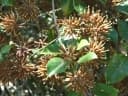
Uncaria guianensis
Uncaria guianensis
Safety & Hazards
None known
Cultivation Details
A plant of mainly low elevations in the tropics, where it can be found at elevations up to 1,000 metres. Succeeds in fairly sunny positions, as on forest edges[1]. Prefers a pH in the range 4.4 - 6.2[1]. The stems are only large enough to harvest when they are 8 years or more old. Generally, it is recommended that the vine is cut at 20 - 100cm above the ground and left to regenerate[1].
Propagation
Seed - it has a very short viability and needs to be sown as soon as it is ripe[1]. Stem cuttings about 20cm long[1]. If the soil of the forest is moist enough, the cuttings are said to be easy to reproduce by directly inserting them into the forest floor. If the conditions are right, the roots develop soon after transplanting[1]. Cite as: Tropical Plants Database, Ken Fern. tropical.theferns.info. 2026-02-20. <tropical.theferns.info/viewtropical.php?id=Uncaria+guianensis>
Pollinators
Data unavailable
References
- [1]New Crops FactSheets — Purdue University · http://www.hort.purdue.edu/newcrop/default.html ↩︎A website dedicated to giving information on potential new agricultural crops.
- [2]Medicinal Plants of the Guianas — DeFilipps, R. A.; Maina, S. L.; & Crepin, J. · Smithsonian Museum · http://botany.si.edu/bdg/medicinal/index.html ↩︎A down-loadable PDF document of a book in pre-publication awaiting illustration. An excellent, if rather terse, guide to the traditional medicinal uses of the plants of the region
- [3]Woods of Northeastern Peru — Williams L. · Field Museum Press; Chicago. · 1936 · http://www.biodiversitylibrary.org/ ↩︎Gives information on the properties of the wood of well over 1,000 species of woody plants from northeastern Peru. Can be downloaded from the Internet.