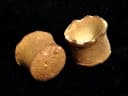
Uncaria gambir
Uncaria gambir
Safety & Hazards
None known
Cultivation Details
A plant of the lowland wet tropics, where it is found at elevations up to 200 metres, but has been successfully cultivated up to 1,000 metres. It grows best in areas where annual daytime temperatures are within the range 25 - 32°c, but can tolerate 20 - 36°c[1]. The plant can survive temperatures down to about 10°c. It prefers a mean annual rainfall in the range 2,200 - 2,400mm, but tolerates 2,000 - 2,600mm[1]. Gambier succeeds in full sun to light shade[1]. It has no special soil requirements, but it is usually cultivated on soils with a rich humus layer, or containing much clay[2]. Requires a well-drained soil[2]. Prefers a pH in the range 6 - 7, tolerating 5.5 - 8[1]. Planting distance is usually 2 x 3 metres or 3 x 3 metres. The seedlings are usually planted in the edge of a hole, and the hole is not filled with soil[2]. No special practices are necessary except weeding during the first year. Fertilizers are usually not applied. Although gambier is a natural climber, no support is needed for cultivated plants when the crop is managed properly[2]. Recently a plant from Sumatra with denser foliage, called 'Uncaria payakumbuh', has been mentioned as a gambier source. The catechin content of this plant is somewhat less than that of 'true' gambier[2].
Propagation
Seed - the very small and light seeds rapidly lose their viability and so should be sown as soon as they are ripe in a nursery seed-bed. To achieve a uniform dispersal, the seeds are often blown into seed-beds and, on slopes, the vertical walls of terraces can be used as the seed-beds[2]. The seed takes about 2 weeks to germinate and can usually be transplanted into the field 2 - 7 months after germination[2]. Cuttings. Layering Vegetative methods of propagation usually result in an advanced first harvest. However, these plants are recorded to contain less tannin at harvest[2]. Cite as: Tropical Plants Database, Ken Fern. tropical.theferns.info. 2026-02-20. <tropical.theferns.info/viewtropical.php?id=Uncaria+gambir>
Pollinators
Data unavailable
References
- [1]Ecocrop — http://ecocrop.fao.org/ecocrop/srv/en/home ↩︎Basic information on a wide range of useful plants, plus details of environmental needs where available.
- [2]World Agroforesty Centre — http://www.worldagroforestry.org/ ↩︎An excellent online database of a huge range of trees giving very good information on each plant - its uses, ecology, identity, propagation, pests etc.
- [3]Mansfeld's Database of Agricultural and Horticultural Plants — http://mansfeld.ipk-gatersleben.de/pls/htmldb_pgrc/f?p=185:3:4292127278597336 ↩︎Terse details of a huge range of useful plants.
- [4]Plant Resources of Southeast Asia — http://proseanet.org/ ↩︎Lots of information on the uses of the plants of SE Asia.