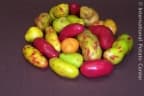
Ullucus tuberosus
Ullucus tuberosus
Safety & Hazards
None known
Cultivation Details
Prefers a rich light soil with plenty of leaf mould[1, 2, 3]. Produces reasonable yields in marginal soils[4]. Established plants are moderately drought tolerant[4]. Prefers a pH in the range 5.5 to 6.5[4]. Ulluco is often cultivated for its edible tubers in S. America[5, 4], it has been tried, unsuccessfully, as a potato substitute in Britain[6]. It is about as hardy as the potato plant in Britain, the foliage withstanding light frosts and the tubers tolerating colder conditions[PFAF]. One report says that plants are very frost-resistant[7] but that has not been our experience[PFAF]. The tubers are not formed until late in the season so a mild autumn is required for good yields. The tubers are formed at the roots and also from shoots growing out of the leaf axils and into the soil[PFAF]. Earthing up the stems as tubers form in late summer can improve yields[4]. Average yields are 5 - 9 tonnes per hectare but there is a lot of potential to increase this[4] Slugs are very fond of this plant and will soon completely destroy it if given a chance[PFAF]. Plants do not usually produce fertile seed but researchers in Finland have obtained seed under controlled circumstances[4].
Propagation
Seed - we have no information on this species but, if you can get hold of any seed, apart from letting us have some you could try sowing it in a warm greenhouse in early spring. Prick out the seedlings into individual pots as soon as they are large enough to handle and either grow them on in pots in the greenhouse for their first year, or plant them out into the soil in the greenhouse. Division of tubers in the late autumn. Harvest them once the top growth has been killed by autumn frosts and store them in a cool but frost-free place over winter. Plant them out in mid spring. Cuttings in summer. Very easy[PFAF]. The stem only needs one leaf node to enable it to root [4]. Cite as: Temperate Plants Database, Ken Fern. temperate.theferns.info. 2026-02-21. <temperate.theferns.info/plant/Ullucus+tuberosus>
Pollinators
Data unavailable
References
- [1]The Vegetable Garden. — Vilmorin. A. · Ten Speed Press · ISBN 0-89815-041-8 ↩︎A reprint of a nineteenth century classic, giving details of vegetable varieties. Not really that informative though.
- [2]The Oxford Book of Food Plants. — Harrison. S. Wallis. M. Masefield. G. · Oxford University Press · 1975 · ISBN - ↩︎Good drawings of some of the more common food plants from around the world. Not much information though.
- [3]The New RHS Dictionary of Gardening. 1992. — Huxley. A. · MacMillan Press · 1992 · ISBN 0-333-47494-5 ↩︎Excellent and very comprehensive, though it contains a number of silly mistakes. Readable yet also very detailed.
- [4]Lost Crops of the Incas — Popenoe. H. et al · National Academy Press · 1990 · ISBN 0-309-04264-X ↩︎An excellent book. Very readable, with lots of information and good pictures of some lesser known food plants of S. America.
- [5]Cornucopia - A Source Book of Edible Plants. — Facciola. S. · Kampong Publications · 1990 · ISBN 0-9628087-0-9 ↩︎Excellent. Contains a very wide range of conventional and unconventional food plants (including tropical) and where they can be obtained (mainly N. American nurseries but also research institutes and a lot of other nurseries from around the world.
- [6]RHS Dictionary of Plants plus Supplement. 1956 — F. Chittendon. · Oxford University Press · 1951 · ISBN - ↩︎Comprehensive listing of species and how to grow them. Somewhat outdated, it has been replaced in 1992 by a new dictionary (see [ 200 ]).
- [7]Economic Botany. — Hill. A. F. · The Maple Press · 1952 · ISBN - ↩︎Not very comprehensive, but it is quite readable and goes into some detail about the plants it does cover.
- [8]A Dictionary of Plants Used by Man. — Usher. G. · Constable · 1974 · ISBN 0094579202 ↩︎Forget the sexist title, this is one of the best books on the subject. Lists a very extensive range of useful plants from around the world with very brief details of the uses. Not for the casual reader.
- [9]Sturtevant's Edible Plants of the World. — Hedrick. U. P. · Dover Publications · 1972 · ISBN 0-486-20459-6 ↩︎Lots of entries, quite a lot of information in most entries and references.
- [10]Alternative Foods. — Sholto-Douglas. J. ↩︎Not very comprehensive, it seems more or less like a copy of earlier writings with little added.
- [PFAF]Plants for a Future — pfaf.org ↩︎