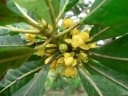
Phyllanthaceae FAMILY
Uapaca guineensis
Uapaca guineensis
Edibility
2/5
Medicinal
2/5
Safety & Hazards
The flowers and bark are sometimes put into Nigerian arrow-poisons as ingredients that are supposed to make the flesh putrefy around the wound[1].
Cultivation Details
HabitEvergreen Tree
GrowthMedium
A plant of the moist to wet tropics. Seedlings are fairly fast growing, both in shade or in full sun, and even in relatively dry localities[2]. They may become 4 - 5 metres tall in 6 years[2]. Plants can flower and fruit all year round[2]. Trees respond well to coppicing and pollarding[2]. A dioecious species, both male and female forms need to be grown if fruit and seed are required[3].
References
- [1]The Useful Plants of West Tropical Africa. — Burkil. H. M. · Royal Botanic Gardens; Kew. · 1985 - 2004 ↩︎Brief descriptions and details of the uses of over 4,000 plants. A superb, if terse, resource, it is also available electronically on the Web - see http://www.aluka.org/
- [2]Protabase - Plant Resources of Tropical Africa. — http://www.prota.org ↩︎An excellent on-line database with detailed information on over 3,200 species of useful plants of Africa.
- [3]Uapaca (Phyllanthaceae) in the Guineo-Congolian forest region: a synoptic revision — Breteler F. J. · Royal Botanical Society of Belgium · 2013 · http://dx.doi.org/10.5091/plecevo.2013.770 · ISBN 2032-3913 ↩︎A revision of the west African members of the genus Uapaca
- [4]African Flowering Plants Database — Conservatoire et Jardin Botaniques. · http://www.ville-ge.ch/musinfo/bd/cjb/africa/recherche.php ↩︎Contains information on over 150,000 plant names (including synonyms) giving a description and habitat, plus a distribution map.
- [5]Dictionary of Economic Plants. — Uphof. J. C. Th. · Weinheim · 1959 · ISBN - ↩︎An excellent and very comprehensive guide but it only gives very short descriptions of the uses without any details of how to utilize the plants. Not for the casual reader.