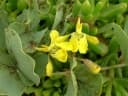
Tylosema esculentum
Tylosema esculentum
Safety & Hazards
None known
Cultivation Details
A plant of the drier tropics, marama bean occurs naturally in an extreme environment with high temperatures and very low rainfall[1]. It can be found at elevations up to 1,500 metres. It grows best in areas where annual daytime temperatures are within the range 22 - 30°c, but can tolerate 16 - 50°c[2]. It prefers a mean annual rainfall in the range 300 - 600mm, but tolerates 150 - 1,600mm[3, 2]. The plant probably survives droughts by drawing on water stored in the tuber, which shrinks greatly in dry years[2]. Requires a sunny position. Grows best in a deep, loose, sandy soil[2]. Prefers a pH in the range 5.5 - 7, tolerating 5 - 7.5[2]. An extremely drought-tolerant plant, it can grow in areas where rainfall is so slight and erratic that in some years almost no rain falls at all[2]. In its native habitat surface water is usually available only for 8 weeks a year, though in the fine-grained sandy soils water may remain in the root zone for as long as 2 months after a rainfall[2]. Unlike most members of this plant family, this species does not form nitrogen nodules on the roots[1].
Propagation
Seed it should not be pre-soaked, though germination might be improved by scarification[1]. Germination starts to take place after about 9 days[1]. Cite as: Tropical Plants Database, Ken Fern. tropical.theferns.info. 2026-02-20. <tropical.theferns.info/viewtropical.php?id=Tylosema+esculentum>
Pollinators
Data unavailable
References
- [1]Protabase - Plant Resources of Tropical Africa. — http://www.prota.org ↩︎An excellent on-line database with detailed information on over 3,200 species of useful plants of Africa.
- [2]Ecocrop — http://ecocrop.fao.org/ecocrop/srv/en/home ↩︎Basic information on a wide range of useful plants, plus details of environmental needs where available.
- [3]Edible Wild Plants of Tanzania — Ruffo, C.K.: Birnie, A. & Tengnas, B. · Regional Land Management Unit; Nairobi. · 2002 · ISBN 9966-896-60-0 ↩︎A very well presented, simple guide to growing and utilizing wild food plants in Tanzania, with line drawings of each plant, a description, habitat and range, non-food as well as food uses, plus basic information on growing the plants.
- [4]Mansfeld's Database of Agricultural and Horticultural Plants — http://mansfeld.ipk-gatersleben.de/pls/htmldb_pgrc/f?p=185:3:4292127278597336 ↩︎Terse details of a huge range of useful plants.
- [5]Cornucopia II — Facciola. S. · Kampong Publications, California. · 1998 · ISBN 0-9628087-2-5 ↩︎The second edition of an excellent guide to the edible uses of plants, though it does not give any details of cultivation etc.
- [6]The Leguminosae; A Source Book of Characteristics, Uses and Nodulation — Allen O.N.; Allen E.K. · University of Wisconsin · 1981 · ISBN 0-333-32221-5 ↩︎An amazing and comprehensive work, giving a brief guide to the many genera of the family Fabaceae and also the principle uses of the genus.