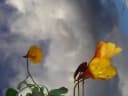
Tropaeolum tuberosum
Tropaeolum tuberosum
Safety & Hazards
None known
Cultivation Details
Anu is a plant of higher elevations in the tropics, where it is found at elevations from 3,000 - 4,300 metres. It can be cultivated at lower elevations in the subtropics and warmer parts of the temperate zone. It grows best in areas where annual daytime temperatures are within the range 12 - 20°c, but can tolerate 4 - 24°c[1]. When dormant, the plant can survive temperatures down to about -2°c, but young growth can be severely damaged at 0°c[1]. It prefers a mean annual rainfall in the range 1,000 - 1,200mm, but tolerates 700 - 1,600mm[1]. Anu is sensitive to the number of hours of daylight in a day and most forms will not flower or form new tubers when the length of daylight is more than 12 hours[2]. Requires a well-drained lime-free soil in a warm sunny position[3, 2, 4]. Grows best with its roots in the shade and top growth in the sun[5]. Prefers a turfy loam or a sandy peaty soil[3]. Prefers a pH in the range 6 - 7, tolerating 5.3 - 7.5[6, 1]. Plants can become dormant in hot dry summers[7]. A potentially very high-yielding species, individual plants can produce up to 4 kilos of tubers - yields of 50 tonnes per hectare are possible[6]. The variety 'Ken Aslet', is daylight neutral, it flowers freely and produces larger tubers than the species[7, 8, 4]. The tubers are formed very near the surface of the soil[7]. The caterpillars of the cabbage white butterfly can be a nuisance and often cause considerable damage to the leaves[9].
Propagation
Seed - sow early spring in a greenhouse. Prick the seedlings out into individual pots once they are large enough to handle and grow them on in the greenhouse for their first winter. Plant out in late spring or early summer, after the last expected frosts. So far we have been unable to obtain seed from plants grown in this country. Division of the tubers in the autumn or spring. In cold winter areas the tubers can be harvested in the autumn after top-growth has died down and they can then be stored in a cool frost-free position until planting them out in the spring. Cuttings of basal stems in the spring[4]. Pot them up into individual pots and place them in light shade in a frame until they are established. Plant out in early summer. Cite as: Temperate Plants Database, Ken Fern. temperate.theferns.info. 2026-02-21. <temperate.theferns.info/plant/Tropaeolum+tuberosum>
Pollinators
Insects
References
- [1]Ecocrop — http://ecocrop.fao.org/ecocrop/srv/en/home ↩︎Basic information on a wide range of useful plants, plus details of environmental needs where available.
- [2]Rare Vegetables for Garden and Table. — Organ. J. · Faber · 1960 · ISBN - ↩︎Unusual vegetables that can be grown outdoors in Britain. A good guide.
- [3]RHS Dictionary of Plants plus Supplement. 1956 — F. Chittendon. · Oxford University Press · 1951 · ISBN - ↩︎Comprehensive listing of species and how to grow them. Somewhat outdated, it has been replaced in 1992 by a new dictionary (see [ 200 ]).
- [4]The New RHS Dictionary of Gardening. 1992. — Huxley. A. · MacMillan Press · 1992 · ISBN 0-333-47494-5 ↩︎Excellent and very comprehensive, though it contains a number of silly mistakes. Readable yet also very detailed.
- [5]Climbers and Wall Shrubs. — Davis. B. · Viking. · 1990 · ISBN 0-670-82929-3 ↩︎Contains information on 2,000 species and cultivars, giving details of cultivation requirements. The text is terse but informative.
- [6]Lost Crops of the Incas — Popenoe. H. et al · National Academy Press · 1990 · ISBN 0-309-04264-X ↩︎An excellent book. Very readable, with lots of information and good pictures of some lesser known food plants of S. America.
- [7]Bulbs — Phillips. R. and Rix. M. · Pan Books · 1989 · ISBN 0-330-30253-1 ↩︎Superbly illustrated, it gives brief details on cultivation and native habitat.
- [8]The Garden. Volume 111. — RHS. · Royal Horticultural Society · 1986 · ISBN - ↩︎Snippets of information from the magazine of the RHS, including an article on Crambe maritima and another on several species thought to be tender that are succeeding in a S. Devon garden.
- [9]Gardening on Walls — Grey-Wilson. C. & Matthews. V. · Collins · 1983 · ISBN 0-00-219220-0 ↩︎A nice little book about plants for growing against walls and a small section on plants that can grow in walls.
- [10]Sturtevant's Edible Plants of the World. — Hedrick. U. P. · Dover Publications · 1972 · ISBN 0-486-20459-6 ↩︎Lots of entries, quite a lot of information in most entries and references.
- [11]A Dictionary of Plants Used by Man. — Usher. G. · Constable · 1974 · ISBN 0094579202 ↩︎Forget the sexist title, this is one of the best books on the subject. Lists a very extensive range of useful plants from around the world with very brief details of the uses. Not for the casual reader.
- [12]The Vegetable Garden. — Vilmorin. A. · Ten Speed Press · ISBN 0-89815-041-8 ↩︎A reprint of a nineteenth century classic, giving details of vegetable varieties. Not really that informative though.
- [13]The Oxford Book of Food Plants. — Harrison. S. Wallis. M. Masefield. G. · Oxford University Press · 1975 · ISBN - ↩︎Good drawings of some of the more common food plants from around the world. Not much information though.
- [14]The Gardener's Assistant. — Thompson. B. · Blackie and Son. · 1878 · ISBN - ↩︎Excellent general but extensive guide to gardening practices in the 19th century. A very good section on fruits and vegetables with many little known species.
- [15]Cornucopia - A Source Book of Edible Plants. — Facciola. S. · Kampong Publications · 1990 · ISBN 0-9628087-0-9 ↩︎Excellent. Contains a very wide range of conventional and unconventional food plants (including tropical) and where they can be obtained (mainly N. American nurseries but also research institutes and a lot of other nurseries from around the world.
- [16]The Ethno-Botany of Pre-Columbian Peru. — Towle. M. A. · Aldine Publishing Co. Chicago. · 1961 ↩︎A very interesting book covering quite a lot of information on plant uses in S. America although many of the plants are not suitable for temperate areas.
- [17]Conservatory and Indoor Plants Volumes 1 & 2 — Phillips. R. & Rix. M. · Pan Books, London. · 1998 · ISBN 0-330-37376-5 ↩︎Excellent photos of over 1,100 species and cultivars with habits and cultivation details plus a few plant uses. Many species are too tender for outdoors in Britain though there are many that can be grown outside.
- [PFAF]Plants for a Future — pfaf.org ↩︎