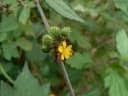
Triumfetta rhomboidea
Triumfetta rhomboidea
Safety & Hazards
None known
Cultivation Details
The plant produces seed capsules covered in hooked spines that adhere strongly to animal fur, clothing etc, and are thus easily transported to new sites. The plant has spread widely through the tropics and has become a noxious weed in many areas, where it invades pastures and disturbed areas in forests[1]. It has been shown to prevent the establishment of native species in disturbed forest sites[1]. Stems for mucilage are harvested by cutting them just above ground level when they are 75 - 100 cm long. They are prepared by removing all leaves and the terminal part where the stem has a diameter of less than 1cm. The resulting sticks are either taken to the homestead or tied into bundles and brought to the market[2].
Propagation
Seed - When cultivated for the mucilage in the stems, cuttings of 15 - 20cm long are taken from the top end of the harvested stems. Since the crop does not perform well under direct sunlight, the cuttings are usually planted in the shade of a tree. They are planted in a circle with a spacing of 10 - 15cm. If the cutting is not planted straight upward, adventitious roots may develop, causing a reduced capacity to produce slime. Therefore, some farmers tie the cuttings to a taller plant, e.g. plantain, to ensure that they grow upright[2]. Cite as: Tropical Plants Database, Ken Fern. tropical.theferns.info. 2026-02-20. <tropical.theferns.info/viewtropical.php?id=Triumfetta+rhomboidea>
Pollinators
Bees
References
- [1]Pacific Island Ecosystems at Risk — http://www.hear.org/pier/scientificnames/index.html ↩︎A very good website detailing weed species that have been introduced into the Pacific Islands.
- [2]Protabase - Plant Resources of Tropical Africa. — http://www.prota.org ↩︎An excellent on-line database with detailed information on over 3,200 species of useful plants of Africa.
- [3]Mansfeld's Database of Agricultural and Horticultural Plants — http://mansfeld.ipk-gatersleben.de/pls/htmldb_pgrc/f?p=185:3:4292127278597336 ↩︎Terse details of a huge range of useful plants.
- [4]Flora Vitiensis Nova — Smith. A.C. · Pacific Tropical Botanical Garden; Hawaii · 1979 · http://www.biodiversitylibrary.org ↩︎A comprehensive flora of Fiji, often showing plant uses. It can be downloaded from the Internet.
- [5]Plant Resources of Southeast Asia — http://proseanet.org/ ↩︎Lots of information on the uses of the plants of SE Asia.
- [6]The Useful Plants of West Tropical Africa. — Burkil. H. M. · Royal Botanic Gardens; Kew. · 1985 - 2004 ↩︎Brief descriptions and details of the uses of over 4,000 plants. A superb, if terse, resource, it is also available electronically on the Web - see http://www.aluka.org/
- [7]Dictionary of Economic Plants. — Uphof. J. C. Th. · Weinheim · 1959 · ISBN - ↩︎An excellent and very comprehensive guide but it only gives very short descriptions of the uses without any details of how to utilize the plants. Not for the casual reader.
- [8]Useful Fiber Plants of the World — Dodge C.R. · USDA; Washington. · 1897 · http://www.biodiversitylibrary.org/ ↩︎A rather dated, but very comprehensive catalogue of fibre plants from around the world. The book can be downloaded from the Internet.