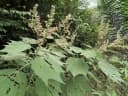
Triumfetta cordifolia
Triumfetta cordifolia
Safety & Hazards
None known
Cultivation Details
A plant of moister areas in the tropics, where it can be found at elevations from sea level to 2,650 metres. Prefers a position with some shade[1]. The seed capsules are covered in hooked bristles that stick to clothing and the fur of animals and are thereby dispersed widely[1]. It is a common weed in cultivated land and not easy to eradicate[1]. Yields of about 260 kg dry fibre per ha have been obtained after 13 days of retting. Six hundred kilos of stems can yield about 100 kg of bark, from which about 10 kg of yarn can be obtained[1]. Stems for mucilage are harvested by cutting them just above ground level when they are 75 - 100 cm long. They are prepared by removing all leaves and the terminal part where the stem has a diameter of less than 1cm. The resulting sticks are either taken to the homestead or tied into bundles and brought to the market[1]. The flowers are a good source of nectar and pollen for bees[1].
Propagation
Seed - fairly easy, a germination rate of 80 - 90% can be expected[1]. When cultivated for the mucilage in the stems, cuttings of 15 - 20cm long are taken from the top end of the harvested stems. Since the crop does not perform well under direct sunlight, the cuttings are usually planted in the shade of a tree. They are planted in a circle with a spacing of 10 - 15cm. If the cutting is not planted straight upward, adventitious roots may develop, causing a reduced capacity to produce slime. Therefore, some farmers tie the cuttings to a taller plant, e.g. plantain, to ensure that they grow upright[1]. Cite as: Tropical Plants Database, Ken Fern. tropical.theferns.info. 2026-02-20. <tropical.theferns.info/viewtropical.php?id=Triumfetta+cordifolia>
Pollinators
Bees
References
- [1]Protabase - Plant Resources of Tropical Africa. — http://www.prota.org ↩︎An excellent on-line database with detailed information on over 3,200 species of useful plants of Africa.
- [2]Edible Wild Plants of Tanzania — Ruffo, C.K.: Birnie, A. & Tengnas, B. · Regional Land Management Unit; Nairobi. · 2002 · ISBN 9966-896-60-0 ↩︎A very well presented, simple guide to growing and utilizing wild food plants in Tanzania, with line drawings of each plant, a description, habitat and range, non-food as well as food uses, plus basic information on growing the plants.
- [PFAF]Plants for a Future — pfaf.org ↩︎