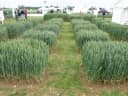
Triticum aestivum
Triticum aestivum
Safety & Hazards
None known
Cultivation Details
Bread wheat arose in southeast Europe and around the Caspian Sea, but is now widely cultivated from near the tropics to the colder regions of the temperate zone. It the tropics it is generally grown at elevations from 1,200 - 3,000 metres, or at lower elevations in the cool season[1, 2]. It grows best in areas where annual daytime temperatures are within the range 15 - 23°c, but can tolerate 5 - 27°c[2]. When dormant, the plant can survive temperatures down to about -20°c, but young growth can be severely damaged at 0°c[2]. It prefers a mean annual rainfall in the range 750 - 900mm, but tolerates 300 - 1,600mm[2]. An easily grown plant, it prefers a sunny position in a rich well-drained soil. Prefers a pH in the range 6 - 7, tolerating 5.5 - 8.5[2]. For floral induction, spring types usually require temperatures between 7 - 18°c for 5 - 15 days, whilst winter types require temperatures between 0 - 7°c for 30 - 60 days. Flowering begins at the middle third of the spike and continues towards the basal and apical parts in 3 - 5 days. All spike-bearing tillers eventually flower almost simultaneously[1]. Wheat is normally self-pollinated; cross-pollination is 1 - 4%[1]. Commercially, wheat is classified into distinct categories of grain hardness (soft, medium-hard, and hard) and colour (red, white and amber)[1]. The complete crop cycle of bread wheat varies from 50 - 200 days in tropical Africa[1]. Maximum recorded grain yields of irrigated winter and spring wheats are 14 and 9.5 tonnes per hectare respectively; the absolute maximum yield, based on genetic potential, is estimated at 20 tonnes. Yields in the tropics are usually lower due to high temperatures and high humidity[1]. Based on growing habit, bread wheat is divided into two subclasses, spring or winter, but facultative types exist[1] There are many named varieties[3]. Grows well with maize and with camomile in small quantities[4]. Dislikes dogwood, cherry, tulips, pine and poppies[4].
Propagation
Seed - sow early spring or autumn in situ and only just cover the seed. Germination should take place within a few days[PFAF]. Cite as: Temperate Plants Database, Ken Fern. temperate.theferns.info. 2026-02-21. <temperate.theferns.info/plant/Triticum+aestivum>
Pollinators
Wind
References
- [1]Protabase - Plant Resources of Tropical Africa. — http://www.prota.org ↩︎An excellent on-line database with detailed information on over 3,200 species of useful plants of Africa.
- [2]Ecocrop — http://ecocrop.fao.org/ecocrop/srv/en/home ↩︎Basic information on a wide range of useful plants, plus details of environmental needs where available.
- [3]Cornucopia - A Source Book of Edible Plants. — Facciola. S. · Kampong Publications · 1990 · ISBN 0-9628087-0-9 ↩︎Excellent. Contains a very wide range of conventional and unconventional food plants (including tropical) and where they can be obtained (mainly N. American nurseries but also research institutes and a lot of other nurseries from around the world.
- [4]Companion Plants. — Philbrick H. and Gregg R. B. · Watkins · 1979 · ISBN - ↩︎Details of beneficial and antagonistic relationships between neighbouring plants.
- [5]RHS Dictionary of Plants plus Supplement. 1956 — F. Chittendon. · Oxford University Press · 1951 · ISBN - ↩︎Comprehensive listing of species and how to grow them. Somewhat outdated, it has been replaced in 1992 by a new dictionary (see [ 200 ]).
- [6]Hamlyn Encyclopaedia of Plants. — Triska. Dr. · Hamlyn · 1975 · ISBN 0-600-33545-3 ↩︎Very interesting reading, giving some details of plant uses and quite a lot of folk-lore.
- [7]The Oxford Book of Food Plants. — Harrison. S. Wallis. M. Masefield. G. · Oxford University Press · 1975 · ISBN - ↩︎Good drawings of some of the more common food plants from around the world. Not much information though.
- [8]Plants for Man. — Schery. R. W. ↩︎Fairly readable but not very comprehensive. Deals with plants from around the world.
- [9]Medicinal Plants of China — Duke. J. A. and Ayensu. E. S. · Reference Publications, Inc. · 1985 · ISBN 0-917256-20-4 ↩︎Details of over 1,200 medicinal plants of China and brief details of their uses. Often includes an analysis, or at least a list of constituents. Heavy going if you are not into the subject.
- [10]Handbook of Chinese Herbs and Formulas. — Yeung. Him-Che. · Institute of Chinese Medicine, Los Angeles · 1985 · ISBN - ↩︎An excellent Chinese herbal giving information on over 500 species. Rather technical and probably best suited to the more accomplished user of herbs.
- [11]Flowers of Europe - A Field Guide. — Polunin. O. · Oxford University Press · 1969 · ISBN 0192176218 ↩︎An excellent and well illustrated pocket guide for those with very large pockets. Also gives some details on plant uses.
- [12]Alternative Enterprises for Agriculture in the UK. — Carruthers. S. P. (Editor) · Centre for Agricultural Strategy, Univ. of Reading · 1986 · ISBN 0704909820 ↩︎Some suggested alternative commercial crops for Britain. Readable. Produced by a University study group.
- [13]Economic Botany. — Hill. A. F. · The Maple Press · 1952 · ISBN - ↩︎Not very comprehensive, but it is quite readable and goes into some detail about the plants it does cover.
- [14]Plant Fibres for Papermaking. — Bell. L. A. · Liliaceae Press · 1988 · ISBN - ↩︎A good practical section on how to make paper on a small scale plus details of about 75 species (quite a few of them tropical) that can be used.
- [15]Dictionary of Economic Plants. — Uphof. J. C. Th. · Weinheim · 1959 · ISBN - ↩︎An excellent and very comprehensive guide but it only gives very short descriptions of the uses without any details of how to utilize the plants. Not for the casual reader.
- [16]A Dictionary of Plants Used by Man. — Usher. G. · Constable · 1974 · ISBN 0094579202 ↩︎Forget the sexist title, this is one of the best books on the subject. Lists a very extensive range of useful plants from around the world with very brief details of the uses. Not for the casual reader.
- [PFAF]Plants for a Future — pfaf.org ↩︎