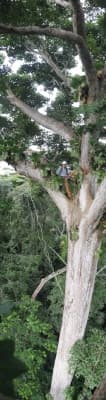
Triplochiton scleroxylon
Triplochiton scleroxylon
Safety & Hazards
The sawdust has been known to cause occupational allergic contact dermatitis, allergic rhinitis and asthma in workers in sawmills[1].
Cultivation Details
A plant of the moist, lowland tropics, where it is found at elevations up to 900 metres. It grows best in areas where annual daytime temperatures are within the range 24 - 30°c, but can tolerate 18 - 36°c[2]. It prefers a mean annual rainfall in the range 1,600 - 2,400mm, but tolerates 1,000 - 4,000mm[2]. Requires a sunny position[2]. Succeeds in most well-drained, fertile soils[2]. Prefers a pH in the range 5.5 - 6.5, tolerating 4.5 - 7.5[2]. A very fast-growing tree. Under natural conditions seedlings may reach 15 metres tall and 15cm in stem diameter after 4 years. Mean annual diameter increment in the forest averages 1cm, but in Nigeria mean annual diameter increments of up to 2.5cm have been recorded and in the Central African Republic as low as 0.3cm. In a 19-year-old plantation in Ghana with 600 stems/ha, the trees were on average 21.8 metres tall with a bole diameter of 27cm[1].
Propagation
Seed - it starts to germinate 1 - 2 weeks after sowing, but the germination rate is often low. Germination rate and speed increase when the seeds are pre-treated by moistening between layers of damp cotton wool[1]. Fruits with wings removed are shallowly buried in pots, which are placed under shade. The seedlings are pricked out when first leaves appear. They are fragile and sensitive to damping off[1]. They develop a taproot, which is often forked, with few lateral roots in the upper 15cm of the soil. The taproot of a 2 metre tall sapling may be 1 metre long[1]. Seedlings of 1 - 3 years old with their tops intact but the root system severely cut back to permit planting in 40 cm × 40 cm × 40 cm holes were successful[1]. However, it has also been observed that cutting the primary root for planting causes serious drawbacks; new roots form slowly, which makes the plant liable to parasitic attacks[1]. The fruits can be collected from the trees when still green just before maturation. Fruits stored at 18°c fully retained their viability for 18 months. However, at 25°c viability drops from about 80% to 15% after 6 months[1]. More than 50% of the seeds may still germinate after being stored for 7.5 years in sealed containers at 4°c[1]. Single-node cuttings with one leaf were rooted successfully under mist; rooting was improved by a hormone dip and a high temperature in the bed (30°c)[1]. Cuttings 10cm long with 2 - 4 leaves taken from 2 month-old branches can be used. These are placed in a nursery under 40 - 60% shade under mist. It takes about 12 weeks to obtain a rooted and hardened plantlet[1]. Marcotting is possible by ringing a branch at an internode; results are optimal when the foliage is at maximum density, between August and October, with up to 50% success in 12-year-old trees[1]. Cite as: Tropical Plants Database, Ken Fern. tropical.theferns.info. 2026-02-20. <tropical.theferns.info/viewtropical.php?id=Triplochiton+scleroxylon>
Pollinators
Data unavailable
References
- [1]Protabase - Plant Resources of Tropical Africa. — http://www.prota.org ↩︎An excellent on-line database with detailed information on over 3,200 species of useful plants of Africa.
- [2]Ecocrop — http://ecocrop.fao.org/ecocrop/srv/en/home ↩︎Basic information on a wide range of useful plants, plus details of environmental needs where available.
- [3]IUCN Red List of Threatened Species — http://www.iucnredlist.org/ ↩︎A list of plants under threat and facing possible extinction, usually with brief details of the threats and information on habitat.
- [4]African Flowering Plants Database — Conservatoire et Jardin Botaniques. · http://www.ville-ge.ch/musinfo/bd/cjb/africa/recherche.php ↩︎Contains information on over 150,000 plant names (including synonyms) giving a description and habitat, plus a distribution map.
- [5]Traditional Vegetables in Benin — Achigan-Dako E. Et al · Darwin Initiative; International Foundation for Science · 2009 ↩︎Issued as a PDF on the Internet, it contains basic information on over 250 species of plants used for food in Benin.
- [6]Tropix 7 — CIRAD · http://tropix.cirad.fr/en ↩︎An on-line guide to the timbers of 245 species of trees.