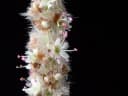
Triplaris americana
Triplaris americana
Safety & Hazards
Hollow stems on the tree are inhabited by small, vicious ants which emerge quickly and attack anyone molesting the tree[1].
Cultivation Details
A plant of mainly low to moderate elevations in the moist tropics, where it is generally found at elevations below 1,200 metres, but found exceptionally at elevations up to 2,500 metres. Prefers a position in full sun[2]. Grows best in a moist soil, tolerating seasonal inundation of the soil[2]. A fast-growing plant, it can be 3 metres tall within 2 years from seed[2]. The tree sprouts readily from the base when it is cut down[3].
Propagation
Seed - it has a short viability of around 4 months and is best sown as soon as it is ripe. Sow the seed in a partially shaded position in a nursery seedbed. A germination rate in excess of 60% can be expected, with the seed sprouting within 15 - 25 days[2]. When the seedlings are 4 - 6cm tall, pot them up into individual containers and they should be ready to plant out 4 - 5 months later[2]. Cite as: Tropical Plants Database, Ken Fern. tropical.theferns.info. 2026-02-20. <tropical.theferns.info/viewtropical.php?id=Triplaris+americana>
Pollinators
Data unavailable
References
- [1]Tropical Timbers of the World. Ag. Handbook No. 607. — Chudnoff. Martin. · USDA Forest Service. Wisconsin. · 1984 ↩︎Terse details on the properties of the wood of almost 400 species of trees from the Tropics.
- [2]Brazilian Trees. Volume 1. 4th Edition. — Lorenzi. H. · Instituto Plantarum De Estudos Da Flora; Brazil. · 2002 · ISBN 85-86714-17-8 ↩︎Information on 350 species of Brazilian trees. Stunning photographs of each species, brief details on the plant, its uses and how to grow it from seed. A superb work, with the minor irritation that the translation from Portuguese is not of the best.
- [3]Common Trees of Puerto Rico and the Virgin Islands — Little E.L.; Wadsworth F.H. · USDA, Forest Service; Washington. · 1964 ↩︎Contains detailed information, and usually an illustration, on 250 tree species, including both native and exotic species.
- [4]Woods of Northeastern Peru — Williams L. · Field Museum Press; Chicago. · 1936 · http://www.biodiversitylibrary.org/ ↩︎Gives information on the properties of the wood of well over 1,000 species of woody plants from northeastern Peru. Can be downloaded from the Internet.
- [5]Dictionary of Economic Plants. — Uphof. J. C. Th. · Weinheim · 1959 · ISBN - ↩︎An excellent and very comprehensive guide but it only gives very short descriptions of the uses without any details of how to utilize the plants. Not for the casual reader.