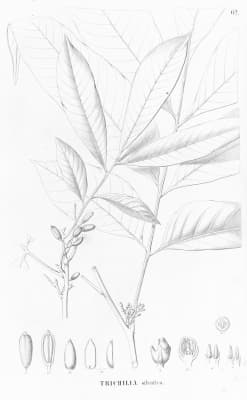
Trichilia silvatica
Trichilia silvatica
Safety & Hazards
None known
Cultivation Details
A tree of the moist lowland tropics, where it is found at elevations up to 400 metres. Succeeds in full sun and in dappled shade[1]. Newly planted young trees establish and grow away moderately well[1].
Propagation
Seed - do not remove the fleshy covering around the seed because it does not tolerate being dried, and has a short viability of up to 1 month[2]. Sow the seed as soon as it is ripe, either in a nursery seedbed or in individual containers, choosing a position in light shade[1]. The germination rate is usually low, with the seed sprouting within a few weeks. Pot up seedbed-grown seedlings into individual pots when they are 4- 5cm tall and they should be ready for planting out into their permanent positions 5 - 7 months later[1]. Cite as: Tropical Plants Database, Ken Fern. tropical.theferns.info. 2026-02-20. <tropical.theferns.info/viewtropical.php?id=Trichilia+silvatica>
Pollinators
Data unavailable
References
- [1]Brazilian Trees. Volume 2. 4th Edition. — Lorenzi. H. · Instituto Plantarum De Estudos Da Flora; Brazil. · 2002 · ISBN 85-86714-15-1 ↩︎Information on 350 species of Brazilian trees. Stunning photographs of each species, brief details on the plant, its uses and how to grow it from seed. A superb work, with the minor irritation that the translation from Portuguese is not of the best.
- [2]Brazilian Trees. Volume 1. 4th Edition. — Lorenzi. H. · Instituto Plantarum De Estudos Da Flora; Brazil. · 2002 · ISBN 85-86714-17-8 ↩︎Information on 350 species of Brazilian trees. Stunning photographs of each species, brief details on the plant, its uses and how to grow it from seed. A superb work, with the minor irritation that the translation from Portuguese is not of the best.
- [3]IUCN Red List of Threatened Species — http://www.iucnredlist.org/ ↩︎A list of plants under threat and facing possible extinction, usually with brief details of the threats and information on habitat.