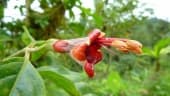
Trichanthera gigantea
Trichanthera gigantea
Safety & Hazards
None known
Cultivation Details
A plant of the humid, lowland tropics, where it is found at elevations up to 400 metres. It grows best in areas where annual daytime temperatures are within the range 27 - 33°c, but can tolerate 20 - 38°c[1]. The plant can survive temperatures down to about -1°c[1]. The plant does not tolerate frost[1]. It prefers a mean annual rainfall in the range 1,500 - 3,000mm, but tolerates 1,000 - 5,000mm[1]. Growing well in full sun, the plant also has considerable shade tolerance[1]. It is well adapted to acid infertile soils[1]. Although commonly found on stream banks, the plant requires well-drained soils[1]. Prefers a pH in the range 5 - 6.5, tolerating 4.5 - 7[1]. A fast-growing plant[2]. The vigorous regrowth of the plant under heavy cutting regimes has led to speculation that nitrogen fixation may occur through the action of mycorrhiza or other organisms[3]
Propagation
Seed - best sown as soon as it is ripe in a partially shaded position in a nursery seedbed[2]. Germination rates are very poor, generally 0 - 2%[4, 3], with the seed sprouting within 25 - 35 days[4]. Seedlings are usually ready to be planted out about 6 months after germination[4]. Stem cuttings will readily form roots in full sun or in light shade[3]. Cuttings 2.2 - 2.8mm in diameter, 20cm long and with at least 2 leaf buds are the most effective in striking roots, with a success rate of 92%[3]. Larger stem cuttings that are more than 1 metre long and 2cm in diameter can also be used in order to quickly produce a living fence[4]. Stems that contact the ground, either through bending or breakage, will root at the nodes to form new plants[3]. Cite as: Tropical Plants Database, Ken Fern. tropical.theferns.info. 2026-02-20. <tropical.theferns.info/viewtropical.php?id=Trichanthera+gigantea>
Pollinators
Bats, Birds, Ants, Bees
References
- [1]Ecocrop — http://ecocrop.fao.org/ecocrop/srv/en/home ↩︎Basic information on a wide range of useful plants, plus details of environmental needs where available.
- [2]Brazilian Trees. Volume 3. — Lorenzi. H. · Instituto Plantarum De Estudos Da Flora; Brazil. · 2009 · ISBN 85-86714-34-4 ↩︎Information on 350 species of Brazilian trees. Stunning photographs of each species, brief details on the plant, its uses and how to grow it from seed. A superb work, with the minor irritation that the translation from Portuguese is not of the best.
- [3]Tropical Forages — http://www.tropicalforages.info/key/Forages/Media/Html/index.htm ↩︎Mainly focussed on forage plants, the site gives a lot of information on the plant, with a good botanical description, details of cultivation, plant uses and a good selection of photographs.
- [4]Tropical Tree Seed Manual — Vosso. J. Editor. · USDA Forest Service. · 2002 · http://www.rngr.net/Publications/ttsm ↩︎An extremely good guide, it can also be downloaded in its entirety from the address shown above.
- [5]Annals of the Missouri Botanical Garden Vol. 65 — Missouri Botanical Garden · 1978 ↩︎An excellent botanical publication, available for download from the Internet. This volume contains parts of the Flora of Panama.
- [6]Woods of Northeastern Peru — Williams L. · Field Museum Press; Chicago. · 1936 · http://www.biodiversitylibrary.org/ ↩︎Gives information on the properties of the wood of well over 1,000 species of woody plants from northeastern Peru. Can be downloaded from the Internet.
- [PFAF]Plants for a Future — pfaf.org ↩︎