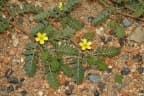
Tribulus terrestris
Tribulus terrestris
Safety & Hazards
None known
Cultivation Details
Tribulus terrestris has a very wide range, from the temperate zone of Eurasia through tropicl regions to southern Africa. The plant grows best in dry, loose, sandy soils and it prospers near sand dunes or loose blown soil by field margins[1]. However, it also grows in heavier soils, especially if they are fertile and moist[2]. The plant can grow on compacted soils such as those found along the sides of unsurfaced roads or in playgrounds[1]. Tolerant of maritime exposure. A problematic weed of farmland[3]. The fruit is dispersed by adhering to the feet of animals and humans or vehicle and bicycle tyres. It also sticks to sheep wool and is often found in hay, straw and manure[1]. The plant is very fast growing from seed[4]. A good bee plant[5].
Propagation
Seed - sow spring in a greenhouse. When they are large enough to handle, prick the seedlings out into individual pots and plant them out after the last expected frost. Cite as: Temperate Plants Database, Ken Fern. temperate.theferns.info. 2026-02-21. <temperate.theferns.info/plant/Tribulus+terrestris>
Pollinators
Bees
References
- [1]Pacific Island Ecosystems at Risk — http://www.hear.org/pier/scientificnames/index.html ↩︎A very good website detailing weed species that have been introduced into the Pacific Islands.
- [2]Native Plants Hawaii — http://nativeplants.hawaii.edu/plant/ ↩︎A website containing information on a range of native Hawaiian plants, with descriptions, habitat, traditional uses etc.
- [3]Edible Wild Plants of Tanzania — Ruffo, C.K.: Birnie, A. & Tengnas, B. · Regional Land Management Unit; Nairobi. · 2002 · ISBN 9966-896-60-0 ↩︎A very well presented, simple guide to growing and utilizing wild food plants in Tanzania, with line drawings of each plant, a description, habitat and range, non-food as well as food uses, plus basic information on growing the plants.
- [4]Flora Europaea — ? · Cambridge University Press · 1964 · ISBN - ↩︎An immense work in 6 volumes (including the index). The standard reference flora for Europe, it is very terse though and with very little extra information. Not for the casual reader.
- [5]Useful Wild Plants in Australia. — Cribb. A. B. and J. W. · William Collins Pty Ltd. Sidney · 1981 · ISBN 0-00-216441-8 ↩︎A very readable book.
- [6]Flora of Japan. (English translation) — Ohwi. G. · Smithsonian Institution · 1965 · ISBN - ↩︎The standard work. Brilliant, but not for the casual reader.
- [7]Flora of China — Missouri Botanical Garden Press; St. Louis. · 1994 · http://flora.huh.harvard.edu/china/ ↩︎An excellent, comprehensive resource in 25 volumes. In addition to the botanical information the flora also gives basic information on habitat and some uses. An on-line version is also available.
- [8]Wild Food in Australia. — Cribb. A. B. and J. W. · Fontana · 1976 · ISBN 0-00-634436-4 ↩︎A very good pocket guide.
- [9]Plants for Human Consumption. — Kunkel. G. · Koeltz Scientific Books · 1984 · ISBN 3874292169 ↩︎An excellent book for the dedicated. A comprehensive listing of Latin names with a brief list of edible parts.
- [10]Medicinal Plants of China — Duke. J. A. and Ayensu. E. S. · Reference Publications, Inc. · 1985 · ISBN 0-917256-20-4 ↩︎Details of over 1,200 medicinal plants of China and brief details of their uses. Often includes an analysis, or at least a list of constituents. Heavy going if you are not into the subject.
- [11]Sturtevant's Edible Plants of the World. — Hedrick. U. P. · Dover Publications · 1972 · ISBN 0-486-20459-6 ↩︎Lots of entries, quite a lot of information in most entries and references.
- [12]Famine Foods listed in the Chiu-Huang Pen-ts'ao. — Reid. B. E. · Southern Materials Centre; Taipei · 1977 · ISBN - ↩︎A translation of an ancient Chinese book on edible wild foods. Fascinating.
- [13]A Modern Herbal. — Grieve. · Penguin · 1984 · ISBN 0-14-046-440-9 ↩︎Not so modern (1930's?) but lots of information, mainly temperate plants.
- [14]A Barefoot Doctors Manual. — ? · Running Press; Philadelphica. · 1977 · ISBN 0-914294-92-X ↩︎A very readable herbal from China, combining some modern methods with traditional chinese methods.
- [15]Handbook of Chinese Herbs and Formulas. — Yeung. Him-Che. · Institute of Chinese Medicine, Los Angeles · 1985 · ISBN - ↩︎An excellent Chinese herbal giving information on over 500 species. Rather technical and probably best suited to the more accomplished user of herbs.
- [16]Chinese Materia Medica. — Stuart. Rev. G. A. · Taipei. Southern Materials Centre · 1911 · ISBN - ↩︎A translation of an ancient Chinese herbal. Fascinating.
- [17]Glossary of Indian Medicinal Plants (Including the Supplement). — Chopra. R. N., Nayar. S. L. and Chopra. I. C. · Council of Scientific and Industrial Research, New Delhi. · 1986 · ISBN - ↩︎Very terse details of medicinal uses of plants with a wide range of references and details of research into the plants chemistry. Not for the casual reader.