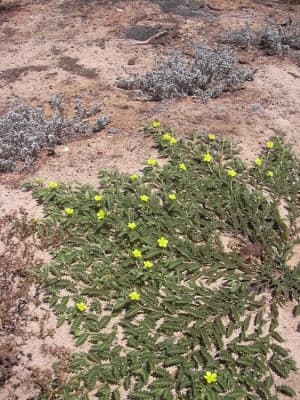
Tribulus cistoides
Tribulus cistoides
Safety & Hazards
The plants produce sharply spined fruits that can cause injury to the feet of humans and other animals[1].
Cultivation Details
Prefers a position in full sun, though it tolerates partial shade[2]. It requires a well-drained soil[2]. Established plants are drought tolerant[2]. Tolerates maritime exposure[2]. Originally native to the Americas, the plant has spread through most of the tropics and subtropics, especially in coastal areas[3]. The fruit is dispersed by adhering to the feet of animals and humans or vehicle and bicycle tyres. It also sticks to sheep wool and is often found in hay, straw and manure[3]. The plant is relatively unharmed by rabbit grazing[2].
Propagation
Seed - Cite as: Tropical Plants Database, Ken Fern. tropical.theferns.info. 2026-02-20. <tropical.theferns.info/viewtropical.php?id=Tribulus+cistoides>
Pollinators
Data unavailable
References
- [1]Flora of Guatemala — Standley P.C. & J. A. Steyermark · 1946 - 1976 · http://www.archive.org/ ↩︎A superb reference, though somewhat dated. Gives lots of plant uses as well as information on plant habit and habitat. The entire flora (13 volumes) can now be downloaded from http://www.archive.org/
- [2]Native Plants Hawaii — http://nativeplants.hawaii.edu/plant/ ↩︎A website containing information on a range of native Hawaiian plants, with descriptions, habitat, traditional uses etc.
- [3]Pacific Island Ecosystems at Risk — http://www.hear.org/pier/scientificnames/index.html ↩︎A very good website detailing weed species that have been introduced into the Pacific Islands.
- [4]Plant Resources of Southeast Asia — http://proseanet.org/ ↩︎Lots of information on the uses of the plants of SE Asia.
- [5]Edible Wild Plants of Tanzania — Ruffo, C.K.: Birnie, A. & Tengnas, B. · Regional Land Management Unit; Nairobi. · 2002 · ISBN 9966-896-60-0 ↩︎A very well presented, simple guide to growing and utilizing wild food plants in Tanzania, with line drawings of each plant, a description, habitat and range, non-food as well as food uses, plus basic information on growing the plants.