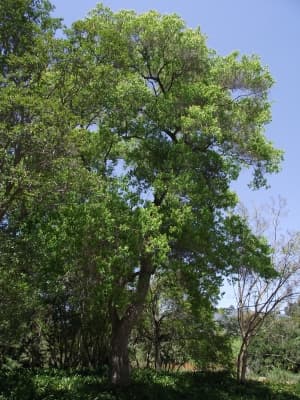
Triadica sebifera
Triadica sebifera
Cultivation Details
Triadica sebifera is a plant of the warm temperate to subtropical zones, it has also been cultivated successfully in tropical areas[4]. It is usually found at elevations from sea level to 800 metres[5]. Optimum conditions for growth are a mean annual rainfall of 1,500 - 3,000mm and a mean annual temperature of 15 - 30°c[5]. Plants can withstand a few degrees of frost[5], with one report that it can tolerate occasional, short-lived temperatures falling as low as -19°c and a mean minimum temperature in the coolest month of 0°c[2]. The plant is shade tolerant and can grow under closed canopies[5]. It is said to thrive in alluvial forests, on low alluvial plains, and on rich leaf-molds, growing best in well-drained clayey-peat soils[6]. It thrives in waterlogged and moist locations and survives salt-water flooding[5]. Grows well on canal banks, steep mountain slopes, granite hills and sandy beaches, succeeding in alkaline, saline or acid soils[6]. Tolerates a wide range of soils within a pH range of 5 - 8[5]. The formation of a taproot allows this species to tolerate extended drought, with dry seasons of up to 5 months[2]. Vegetable tallow is a fast grower, increasing in height by around 1 metre a year for its first 8 - 10 years, It can be 13 metres tall at the age of 20 years, with a bole 40cm in diameter[4]. Plants require from 3 - 8 years to commence bearing, but then continue to bear for an average of 70 - 100 years[6]. Yields of 14 tonnes of seed per hectare, containing 2.6 tonnes of oil and 2.8 tones of tallow have been achieved[6]. This yield could increase with age[6]. Many named varieties have been developed in the Orient, especially in Taiwan, for improved oil production[6]. Responds well to coppicing[7, 4].
Propagation
Seed - do not cold stratify the seed since this can lead to secondary dormancy. Sown in mid spring in a warm greenhouse, it usually germinates within 4 weeks[8]. Prick out the seedlings into individual pots when they are large enough to handle. Overwinter in a greenhouse for at least their first 2 winters and plant out in late spring. Cuttings of half-ripe wood, mid summer in a frame. Layering Suckers Cite as: Temperate Plants Database, Ken Fern. temperate.theferns.info. 2026-02-21. <temperate.theferns.info/plant/Triadica+sebifera>
Pollinators
Bees, Insects,
References
- [1]The New RHS Dictionary of Gardening. 1992. — Huxley. A. · MacMillan Press · 1992 · ISBN 0-333-47494-5 ↩︎Excellent and very comprehensive, though it contains a number of silly mistakes. Readable yet also very detailed.
- [2]Invasive Species Compendium — http://www.cabi.org ↩︎An immense resource - in depth information on over 900 species of invasive plants (it also has information on animals, fungi etc).
- [3]Poisonous Plants of North Carolina — http://www.ces.ncsu.edu/depts/hort/consumer/poison/poison.htm ↩︎An excellent concise but comprehensive guide to toxic plants that grow in N. Carolina. It lists even those plants that are of very low toxicity, including several well-known food plants such as carrots and potatoes.
- [4]Protabase - Plant Resources of Tropical Africa. — http://www.prota.org ↩︎An excellent on-line database with detailed information on over 3,200 species of useful plants of Africa.
- [5]World Agroforesty Centre — http://www.worldagroforestry.org/ ↩︎An excellent online database of a huge range of trees giving very good information on each plant - its uses, ecology, identity, propagation, pests etc.
- [6]Handbook of Energy Crops — Duke. J. · - · 1983 · https://hort.purdue.edu/newcrop/duke_energy/dukeindex.html · ISBN - ↩︎Published only on the Internet, excellent information on a wide range of both temperate and tropical plants.
- [7]A Manual of Indian Timbers. — Gamble. J. S. · Bishen Singh Mahendra Pal Singh · 1972 · ISBN - ↩︎First written in the 19th century, but still a classic, giving a lot of information on the uses and habitats of Indian trees. Not for the casual reader.
- [8]The Reference Manual of Woody Plant Propagation. — Dirr. M. A. and Heuser. M. W. · Athens Ga. Varsity Press · 1987 · ISBN 0942375009 ↩︎A very detailed book on propagating trees. Not for the casual reader.
- [9]The RHS Gardener's Encyclopedia of Plants and Flowers — Brickell. C. · Dorling Kindersley Publishers Ltd. · 1990 · ISBN 0-86318-386-7 ↩︎Excellent range of photographs, some cultivation details but very little information on plant uses.
- [10]Dictionary of Economic Plants. — Uphof. J. C. Th. · Weinheim · 1959 · ISBN - ↩︎An excellent and very comprehensive guide but it only gives very short descriptions of the uses without any details of how to utilize the plants. Not for the casual reader.
- [11]Illustrated Flora of North Central Texas — Diggs, Jnr. G.M.; Lipscomb. B. L. & O'Kennon. R. J · Botanical Research Institute, Texas. · 1999 · http://artemis.austincollege.edu/acad/bio/gdiggs/NCTXpdf.htm · ISBN 1-889878-01-4 ↩︎An excellent flora, which is also available on-line.
- [12]Flora of China — Missouri Botanical Garden Press; St. Louis. · 1994 · http://flora.huh.harvard.edu/china/ ↩︎An excellent, comprehensive resource in 25 volumes. In addition to the botanical information the flora also gives basic information on habitat and some uses. An on-line version is also available.
- [13]Tanaka's Cyclopedia of Edible Plants of the World. — Tanaka. T. & Nakao S. · Keigaku Publishing; Tokyo · 1976 · ISBN - ↩︎The most comprehensive list of edible plants I've come across. Only the briefest entry for each species, though, and some of the entries are more than a little dubious. Not for the casual reader.
- [14]Cornucopia - A Source Book of Edible Plants. — Facciola. S. · Kampong Publications · 1990 · ISBN 0-9628087-0-9 ↩︎Excellent. Contains a very wide range of conventional and unconventional food plants (including tropical) and where they can be obtained (mainly N. American nurseries but also research institutes and a lot of other nurseries from around the world.
- [15]Medicinal Plants of China — Duke. J. A. and Ayensu. E. S. · Reference Publications, Inc. · 1985 · ISBN 0-917256-20-4 ↩︎Details of over 1,200 medicinal plants of China and brief details of their uses. Often includes an analysis, or at least a list of constituents. Heavy going if you are not into the subject.
- [16]Trees and Shrubs Hardy in Great Britain. Vol 1 - 4 and Supplement. — Bean. W. · Murray · 1981 · ISBN - ↩︎A classic with a wealth of information on the plants, but poor on pictures.
- [17]Plantae Wilsonae. Vol 1 - 3 — Wilson. E. H. · University Press; Cambridge. · 1911 - 1917 · http://www.biodiversitylibrary.org ↩︎Details of the palnts collected by the plant collector E. H. Wilson on his travels in China. Gives some habitats. Not for the casual reader. It can be downloaded from the internet.
- [18]A Modern Herbal. — Grieve. · Penguin · 1984 · ISBN 0-14-046-440-9 ↩︎Not so modern (1930's?) but lots of information, mainly temperate plants.
- [19]A Barefoot Doctors Manual. — ? · Running Press; Philadelphica. · 1977 · ISBN 0-914294-92-X ↩︎A very readable herbal from China, combining some modern methods with traditional chinese methods.
- [20]Chinese Materia Medica. — Stuart. Rev. G. A. · Taipei. Southern Materials Centre · 1911 · ISBN - ↩︎A translation of an ancient Chinese herbal. Fascinating.
- [21]Glossary of Indian Medicinal Plants (Including the Supplement). — Chopra. R. N., Nayar. S. L. and Chopra. I. C. · Council of Scientific and Industrial Research, New Delhi. · 1986 · ISBN - ↩︎Very terse details of medicinal uses of plants with a wide range of references and details of research into the plants chemistry. Not for the casual reader.
- [22]RHS Dictionary of Plants plus Supplement. 1956 — F. Chittendon. · Oxford University Press · 1951 · ISBN - ↩︎Comprehensive listing of species and how to grow them. Somewhat outdated, it has been replaced in 1992 by a new dictionary (see [ 200 ]).
- [23]Flowering Plants of the World. — Haywood. V. H. · Oxford University Press · ISBN 0-19-217674-9 ↩︎Very readable and well illustrated, it lists plants by families giving the basic diagnostic features and some details of plant uses.
- [24]Economic Botany. — Hill. A. F. · The Maple Press · 1952 · ISBN - ↩︎Not very comprehensive, but it is quite readable and goes into some detail about the plants it does cover.
- [25]Forest Flora of Chakrata, Dehra Dun and Saharanpur. — Gupta. B. L. · Forest Research Institute Press · 1945 · ISBN - ↩︎A good flora for the middle Himalayan forests, sparsly illustrated. Not really for the casual reader.
- [PFAF]Plants for a Future — pfaf.org ↩︎