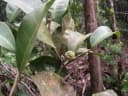
Treculia africana
Treculia africana
Safety & Hazards
The sap of the male tree is caustic and toxic, though the sap from female trees is used medicinally[1].
Cultivation Details
Tolerant of a wide range of climatic conditions, it will thrive in most tropical and subtropical regions at elevations up to 1,500 metres[2]. It is found in areas where the mean annual rainfall is within the range 1,250 - 3,000mm, and the mean annual temperature ranges from 22 - 35°c[2]. Prefers a rich, deep, moisture-retentive soil and a position in partial shade or full sun[2]. It is not a very light demanding plant, and will grow in a wide variety of soils[2]. Plants start to fruit when about 4 years old[2]. Under favourable climatic conditions and in a good soil, 120 - 200 kilos of dried grains can be harvested in a year from each tree; this would translate to between 5 - 10 tonnes per hectare[2]. A fairly fast-growing tree. There is a striking variation in the number of fruit heads produced by trees belonging to T. Africana var. africana (with large fruit heads) and T. Africana var. inversa (with small fruit heads). The former is clearly superior in the weight of seeds produced while the latter produces more fruit and also produces twice as many branches[2].
Propagation
Propagation is by seedlings, which are sown in pots, and direct spot sowing at site. Pre-treatment of seeds is not necessary. It is also propagated through budding, cuttings and shield grafting. Using adult scions, budded trees have produced fruits with viable seeds within 2-4 years. With juvenile cuttings, one can obtain 69% rooting. Where climatic conditions are favourable, fruit collection is possible throughout the year Cite as: Tropical Plants Database, Ken Fern. tropical.theferns.info. 2026-02-20. <tropical.theferns.info/viewtropical.php?id=Treculia+africana>
Pollinators
Data unavailable
References
- [1]Tropical and Subtropical Trees - A Worldwide Encyclopaedic Guide. — Barwick. M. · Thames & Hudson, London · 2004 · ISBN 0-500-51181-0 ↩︎A superb book, very concise and well written, giving a wealth of information on 400 or more species including descriptions, habitat, cultivation details and plant uses. A wealth of colour photographs bring each plant vividly to life.
- [2]World Agroforesty Centre — http://www.worldagroforestry.org/ ↩︎An excellent online database of a huge range of trees giving very good information on each plant - its uses, ecology, identity, propagation, pests etc.
- [3]Edible Wild Plants of Tanzania — Ruffo, C.K.: Birnie, A. & Tengnas, B. · Regional Land Management Unit; Nairobi. · 2002 · ISBN 9966-896-60-0 ↩︎A very well presented, simple guide to growing and utilizing wild food plants in Tanzania, with line drawings of each plant, a description, habitat and range, non-food as well as food uses, plus basic information on growing the plants.
- [4]Nuts. — Howes. F. N. · Faber · 1948 · ISBN - ↩︎Rather old but still a masterpiece. Has sections on tropical and temperate plants with edible nuts plus a section on nut plants in Britain. Very readable.
- [5]Dictionary of Economic Plants. — Uphof. J. C. Th. · Weinheim · 1959 · ISBN - ↩︎An excellent and very comprehensive guide but it only gives very short descriptions of the uses without any details of how to utilize the plants. Not for the casual reader.
- [6]Flora Zambesiaca — http://apps.kew.org/efloras/fz/intro.html ↩︎An excellent online flora of plants from the Zambezi River basin. It lists a number of the plant uses as well as the habitats and botanical descriptions of the plants.
- [7]Cornucopia II — Facciola. S. · Kampong Publications, California. · 1998 · ISBN 0-9628087-2-5 ↩︎The second edition of an excellent guide to the edible uses of plants, though it does not give any details of cultivation etc.
- [8]Perennial Edible Fruits of the Tropics : an Inventory — Martin, F. W.; Campbell, C. W.; Rubertbe, R. M. · U.S. Dept. of Agriculture, Agricultural Research Service · 1987 ↩︎A booklet giving terse details of almost 300 species of edible fruits, plus regional lists of Botanical and Common names for over 2,500 less well-known edible fruits of the tropics.