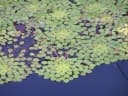
Cultivation Details
Trapa natans has a very wide native range, being found in the temperate and tropical zones of Europe, Asia and Africa and at elevations up to 1,500 metres. It grows best in areas where annual daytime temperatures are within the range 15 - 25°c, but can tolerate 10 - 35°c[3]. When dormant, the plant (in the form of a seed) can survive temperatures down to about -25°c, but young growth can be severely damaged at 0°c[3]. It prefers a mean annual rainfall in the range 500 - 1,200mm, but tolerates 300 - 1,600mm[3]. A water plant, usually growing in water up to 60cm deep, but recorded to tolerate depths from 30 - 360cm[4]. It requires a sunny position in slightly acidic water[1]. Dislikes calcium rich water[5]. Prefers a rich soil[5, 6, 1]. Prefers a pH in the range 5.5 - 7.5, tolerating 5 - 8.2[3]. In India, the fruit is broadcast in 30 - 69 cm deep nursery ponds and pressed into the mud, transplanted at the 4 - 5 leaf stage and replanted when 4 - 5 months old. Lateral pruning is carried out to accelerate flowering and fruiting[7]. In China, the water chestnut is cultivated in running water[7]. The plant is known to fix nitrogen from the water[4]. Trapa natans is a very variable species that is recognized as comprising 8 distinct varieties (see notes above on taxonomy). All the varieties will produce edible seeds as per the species, though we only have clear records for some of them. The varieties are:- Trapa natans var. africana Brenan. Native to eastern tropical Africa, mainly in Lake Victoria. Trapa natans var. bispinosa (Roxb.) Makino. One of the cultivated varieties, see separate record sheet for more info. Trapa natans var. japonica Nakai. Found in the temperate climate of Japan and Korea. Trapa natans var. magnicorona (Z.T.Xiong) B.Y.Ding & X.F.Jin. Found in the temperate climate of Russian Far East, eastern China, Japan and Korea. Trapa natans var. natans. The base variety upon which this record sheet is based. Trapa natans var. pseudincisa (Nakai) ined. Found in the temperate climate o Russian Far East, easern and central China, Japan and Korea, Trapa natans var. quadricaudata (Glück) B.Y.Ding & X.F.Jin. Found mainly in subtropical climates from Russian Far East, Japan, eastern China and southeast Asia, with outliers in Africa. Trapa natans var. quadrispinosa (Roxb.) Makino. This form is known to be cultivated in China, see separate record sheet for more info. There are some named varieties[8, 7].
Propagation
Seed - harvest in late summer and store overwinter in a jar of water in a cold but frost-free place. The seed can remain viable for up to 10 years in the soil at the bottom of ponds etc, though it quickly loses its vitality if it is allowed to become dry. Sow in spring, placing one seed in each pot and submerging them under a few centimetres of water. Cite as: Temperate Plants Database, Ken Fern. temperate.theferns.info. 2026-02-21. <temperate.theferns.info/plant/Trapa+natans>
Pollinators
Insects, Self
References
- [1]The New RHS Dictionary of Gardening. 1992. — Huxley. A. · MacMillan Press · 1992 · ISBN 0-333-47494-5 ↩︎Excellent and very comprehensive, though it contains a number of silly mistakes. Readable yet also very detailed.
- [2]Oriental Vegetables — Larkcom J. · John Murray · 1991 · ISBN 0-7195-4781-4 ↩︎Well written and very informative.
- [3]Ecocrop — http://ecocrop.fao.org/ecocrop/srv/en/home ↩︎Basic information on a wide range of useful plants, plus details of environmental needs where available.
- [4]Invasive Species Compendium — http://www.cabi.org ↩︎An immense resource - in depth information on over 900 species of invasive plants (it also has information on animals, fungi etc).
- [5]Flora Europaea — ? · Cambridge University Press · 1964 · ISBN - ↩︎An immense work in 6 volumes (including the index). The standard reference flora for Europe, it is very terse though and with very little extra information. Not for the casual reader.
- [6]Complete Guide to Water Plants. — Muhlberg. H. · E. P. Publishing Ltd. · 1982 · ISBN 0-7158-0789-7 ↩︎Deals with a wide range of plants for temperate areas (and indoor aquaria) with quite a lot of information on cultivation techniques.
- [7]Edible Nuts. — Wickens G.E. · FAO, Rome. · 1995 · http://www.fao.org/docrep/ · ISBN 92-5-103748-5 ↩︎Detailed information on 20 of the most valuable nut crops, plus more basic information on a wide range of other nut-producing plants. It can be downloaded from the Internet.
- [8]Cornucopia - A Source Book of Edible Plants. — Facciola. S. · Kampong Publications · 1990 · ISBN 0-9628087-0-9 ↩︎Excellent. Contains a very wide range of conventional and unconventional food plants (including tropical) and where they can be obtained (mainly N. American nurseries but also research institutes and a lot of other nurseries from around the world.
- [9]Flora of China — Missouri Botanical Garden Press; St. Louis. · 1994 · http://flora.huh.harvard.edu/china/ ↩︎An excellent, comprehensive resource in 25 volumes. In addition to the botanical information the flora also gives basic information on habitat and some uses. An on-line version is also available.
- [10]Trapa natans (Water Chestnut): An Overview — Shalabh B., Akash J. & Jasmine C. · 2012 · http://www.irjponline.com · ISBN 2230-8407 ↩︎
- [11]IUCN Red List of Threatened Species — http://www.iucnredlist.org/ ↩︎A list of plants under threat and facing possible extinction, usually with brief details of the threats and information on habitat.
- [12]Sturtevant's Edible Plants of the World. — Hedrick. U. P. · Dover Publications · 1972 · ISBN 0-486-20459-6 ↩︎Lots of entries, quite a lot of information in most entries and references.
- [13]Growing Unusual Fruit. — Simmons. A. E. · David & Charles; Newton Abbot. · 1972 · ISBN 0-7153-5531-7 ↩︎A very readable book with information on about 100 species that can be grown in Britain (some in greenhouses) and details on how to grow and use them.
- [14]Hamlyn Encyclopaedia of Plants. — Triska. Dr. · Hamlyn · 1975 · ISBN 0-600-33545-3 ↩︎Very interesting reading, giving some details of plant uses and quite a lot of folk-lore.
- [15]The Oxford Book of Food Plants. — Harrison. S. Wallis. M. Masefield. G. · Oxford University Press · 1975 · ISBN - ↩︎Good drawings of some of the more common food plants from around the world. Not much information though.
- [16]Nuts. — Howes. F. N. · Faber · 1948 · ISBN - ↩︎Rather old but still a masterpiece. Has sections on tropical and temperate plants with edible nuts plus a section on nut plants in Britain. Very readable.
- [17]Flora of the USSR. — Komarov. V. L. · Israel Program for Scientific Translation · 1968 · http://www.biodiversitylibrary.org · ISBN - ↩︎An immense (25 or more large volumes) and not yet completed translation of the Russian flora. Full of information on plant uses and habitats but heavy going for casual readers. It can be downloaded from the Internet.
- [18]Flowers of Europe - A Field Guide. — Polunin. O. · Oxford University Press · 1969 · ISBN 0192176218 ↩︎An excellent and well illustrated pocket guide for those with very large pockets. Also gives some details on plant uses.
- [19]The Vegetable Garden. — Vilmorin. A. · Ten Speed Press · ISBN 0-89815-041-8 ↩︎A reprint of a nineteenth century classic, giving details of vegetable varieties. Not really that informative though.
- [20]Dictionary of Economic Plants. — Uphof. J. C. Th. · Weinheim · 1959 · ISBN - ↩︎An excellent and very comprehensive guide but it only gives very short descriptions of the uses without any details of how to utilize the plants. Not for the casual reader.
- [21]The Book of Edible Nuts. — Rosengarten. jnr. F. · Walker & Co. · 1984 · ISBN 0802707699 ↩︎A very readable and comprehensive guide. Well illustrated.