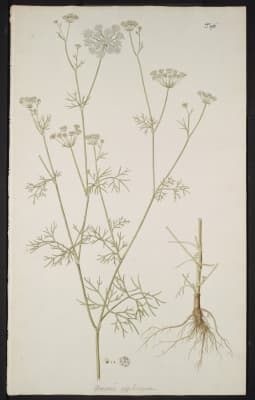
Trachyspermum ammi
Trachyspermum ammi
Safety & Hazards
None known
Cultivation Details
Ajowan is a plant mainly of temperate areas with hot summers, though it can also be grown in the tropics and subtropics, where it is cultivated at elevations from near sea level up to 2,200 metres. It grows best in areas where annual daytime temperatures are within the range 16 - 24°c, but can tolerate 10 - 30°c[1]. It prefers a mean annual rainfall in the range 800 - 1,000mm, but tolerates 700 - 1,100mm[1]. Requires a moist soil in a sunny position[2]. Prefers loamy soils that are not too heavy, though it can be grown on all types of soils[3]. Wet-rice-growing soils are considered unsuitable, however, as they promote vegetative development at the cost of flowering[3]. Prefers a pH in the range 6.5 - 7.5, tolerating 6 - 8[1]. Flowering commences 2 - 4 months after sowing, and the seeds are ripe 2 months later[3]. About70 - 80% of the crop is cross-pollinated, and pollination is primarily done by bees[3]. As the plants are widely branched, flowering occurs unevenly, thus seeds mature unevenly, which makes them difficult to harvest[3]. The seeds are often harvested before they are fully ripe, to prevent loss due to shattering[3]. The essential oil quality of these fruits is considered the same as that of the ripe fruits[3]. In India, yields of traditionally grown Ajowan are higher under dry rain-fed conditions than under irrigation, and amount to about 225 kg/ha of fruits. Improved cultivars may give yields of 1.2 - 2.2 tonnes/ha and in 1997 an improved cultivar yielded 82 kg/ha essential oil[3]. There are some named varieties[4].
Propagation
Seed - we have no information for this species, but suggest that you try sowing the seed in situ in mid spring. If this is not successful, then an earlier sowing in the greenhouse in early spring, planting out after the last expected frosts might be better[PFAF]. It is quite possible that this species will not like to be transplanted, so either sow 4 - 5 seeds per pot, or sow in a tray and transplant to individual pots as soon as the seedlings are big enough to handle[PFAF]. Cite as: Temperate Plants Database, Ken Fern. temperate.theferns.info. 2026-02-21. <temperate.theferns.info/plant/Trachyspermum+ammi>
Pollinators
Bees
References
- [1]Ecocrop — http://ecocrop.fao.org/ecocrop/srv/en/home ↩︎Basic information on a wide range of useful plants, plus details of environmental needs where available.
- [2]Encyclopaedia of Herbs and their Uses. — Bown. D. · Dorling Kindersley, London. · 1995 · ISBN 0-7513-020-31 ↩︎A very well presented and informative book on herbs from around the globe. Plenty in it for both the casual reader and the serious student. Just one main quibble is the silly way of having two separate entries for each plant.
- [3]Plant Resources of Southeast Asia — http://proseanet.org/ ↩︎Lots of information on the uses of the plants of SE Asia.
- [4]Cornucopia II — Facciola. S. · Kampong Publications, California. · 1998 · ISBN 0-9628087-2-5 ↩︎The second edition of an excellent guide to the edible uses of plants, though it does not give any details of cultivation etc.
- [5]Flora of Pakistan — http://www.efloras.org ↩︎As of 2006, there is not much information on habitats available, but it is being developed and promises to be an excellent resource.
- [6]Indian Medicinal Plants; An Illustrated Dictionary — Khare C.P. (Ed.) · Springer-Verlag Berlin/Heidelberg · 2007 · ISBN 978-0-387-70637-5 ↩︎
- [7]Glossary of Indian Medicinal Plants (Including the Supplement). — Chopra. R. N., Nayar. S. L. and Chopra. I. C. · Council of Scientific and Industrial Research, New Delhi. · 1986 · ISBN - ↩︎Very terse details of medicinal uses of plants with a wide range of references and details of research into the plants chemistry. Not for the casual reader.
- [8]Flora of China — Missouri Botanical Garden Press; St. Louis. · 1994 · http://flora.huh.harvard.edu/china/ ↩︎An excellent, comprehensive resource in 25 volumes. In addition to the botanical information the flora also gives basic information on habitat and some uses. An on-line version is also available.
- [9]Dictionary of Economic Plants. — Uphof. J. C. Th. · Weinheim · 1959 · ISBN - ↩︎An excellent and very comprehensive guide but it only gives very short descriptions of the uses without any details of how to utilize the plants. Not for the casual reader.
- [PFAF]Plants for a Future — pfaf.org ↩︎