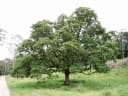
Toona ciliata
Toona ciliata
Safety & Hazards
Sawdust from machining operations has been reported to cause dermatitis in some individuals[1].
Cultivation Details
A plant of the moist to wet tropics and subtropics, where it is found at elevations from 400 - 2,800 metres[2, 3]. It grows best in areas where annual daytime temperatures are within the range 18 - 34°c, but can tolerate 8 - 48°c[3]. When dormant, the plant can survive temperatures down to about -3°c, but young growth can be severely damaged at 0°c[3]. It prefers a mean annual rainfall in the range 1,100 - 3,000mm, but tolerates 750 - 4,500mm[3]. Young trees require some protection from direct sun, but become more light demanding as they grow older[3]. Prefers a rich, deep, water-retentive soil[4]. Does not do well on wet, compacted or poor sandy ones[1]. Prefers a pH in the range 5.5 - 6.5, tolerating 4.5 - 7.5[3]. Widely grown as a timber tree, it has wind-dispersed seeds and has become naturalized in some areas. It needs to be monitored for potential invasiveness[5]. Toona ciliata grows rapidly[6]. In Hawaii an average tree height of 10 metres and an average bole diameter of 9.6 cm had been reached after 8.7 years[6]. Trees may reach a height of 35 metres with a bole diameter of 70 cm when 40 years old[6]. In plantations in tropical Africa, growth declines seriously after 40 years[6]. Trees planted in open localities may already flower and produce seed after 6 years[6]. It coppices well and produces plentiful root suckers[1]. The tree has a spreading superficial root system, which may have adverse effects on the growth of agricultural crops[1]. The tendency to become branchy should be controlled by close initial spacing. Thinning is required from the 4th year, and thereafter every 5 years[1]. A very variable tree[2].
Propagation
Seed - germinates quicker and better under shade[1]. It should be broadcast thinly on raised and shaded nursery beds soon after collection[1]. Germination takes 8 - 15 days and fresh seed has a germination rate of 50 - 80%[1]. Natural regeneration is profuse even in areas outside its natural range. Good natural reproduction can be induced by clearing the ground in the vicinity of seed bearers[1]. Orthodox seed storage behaviour; 90% germination after 12 months’ storage in polythene bags at 5 - 8°c with 34-12.9% mc; complete loss of viability after 3 months at room temperature[1]. Cite as: Tropical Plants Database, Ken Fern. tropical.theferns.info. 2026-02-20. <tropical.theferns.info/viewtropical.php?id=Toona+ciliata>
Pollinators
Bees, Moths
References
- [1]World Agroforesty Centre — http://www.worldagroforestry.org/ ↩︎An excellent online database of a huge range of trees giving very good information on each plant - its uses, ecology, identity, propagation, pests etc.
- [2]Flora of China — Missouri Botanical Garden Press; St. Louis. · 1994 · http://flora.huh.harvard.edu/china/ ↩︎An excellent, comprehensive resource in 25 volumes. In addition to the botanical information the flora also gives basic information on habitat and some uses. An on-line version is also available.
- [3]Ecocrop — http://ecocrop.fao.org/ecocrop/srv/en/home ↩︎Basic information on a wide range of useful plants, plus details of environmental needs where available.
- [4]Tropical and Subtropical Trees - A Worldwide Encyclopaedic Guide. — Barwick. M. · Thames & Hudson, London · 2004 · ISBN 0-500-51181-0 ↩︎A superb book, very concise and well written, giving a wealth of information on 400 or more species including descriptions, habitat, cultivation details and plant uses. A wealth of colour photographs bring each plant vividly to life.
- [5]Pacific Island Ecosystems at Risk — http://www.hear.org/pier/scientificnames/index.html ↩︎A very good website detailing weed species that have been introduced into the Pacific Islands.
- [6]Protabase - Plant Resources of Tropical Africa. — http://www.prota.org ↩︎An excellent on-line database with detailed information on over 3,200 species of useful plants of Africa.
- [7]IUCN Red List of Threatened Species — http://www.iucnredlist.org/ ↩︎A list of plants under threat and facing possible extinction, usually with brief details of the threats and information on habitat.
- [8]Plants and People of Nepal — Manandhar. N. P. · Timber Press. Oregon. · 2002 · ISBN 0-88192-527-6 ↩︎Excellent book, covering over 1,500 species of useful plants from Nepal together with information on the geography and peoples of Nepal. Good descriptions of the plants with terse notes on their uses.
- [9]Dictionary of Economic Plants. — Uphof. J. C. Th. · Weinheim · 1959 · ISBN - ↩︎An excellent and very comprehensive guide but it only gives very short descriptions of the uses without any details of how to utilize the plants. Not for the casual reader.
- [10]Flora Malesiana Series 1 — Various · Nationaal Herbarium Nederiand, Universiteit Leiden branch · http://www.archive.org ↩︎A massive treatment of the plants of the Malaysian Archipelago. Much of it has been made available to download from the Internet
- [11]Australian Tropical Rainforest Plants — http://www.anbg.gov.au/cpbr/cd-keys/rfk/index.html ↩︎An online resource giving botanical information, and a little bit about plant usage, for over 2,700 species of plants found in the Australian rainforest.