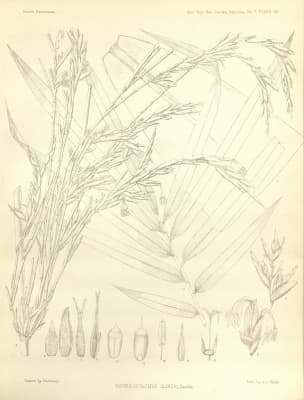
Thyrsostachys oliveri
Thyrsostachys oliveri
Safety & Hazards
None known
Cultivation Details
Bamboos have an interesting method of growth. Each plant produces a number of new stems annually - these stems grow to their maximum height in their first year of growth, subsequent growth in the stem being limited to the production of new side branches and leaves. In the case of some mature tropical species the new stem could be as much as 30 metres tall, with daily increases in height of 30cm or more during their peak growth time. This makes them some of the fastest-growing species in the world[PFAF]. Bamboos in general are usually monocarpic, living for many years before flowering, then flowering and seeding profusely for a period of 1 - 3 years before usually dying.
Propagation
Seed - when stored at room temperature, the seeds gradually lose viability over a period of 12 - 18 months[1]. In cool storage at 2 - 4°c, good viability is retained for at least two years[1]. The seed is best sown fresh, when it germinates within days, with 90 - 95% of the seeds sprouting[1]. Rhizome cuttings. The cuttings are taken from 1-year-old culms and comprise a length of rhizome with roots plus a culm that can be up to 1 metre long. This is planted in a nursery for 2 - 3 months and then transplanted to the field in the rainy season. In general, 10 rhizome cuttings can be taken from a 5 - 6-year-old clump, retaining 4 - 5 one-year-old culms in the clump[1]. Cite as: Tropical Plants Database, Ken Fern. tropical.theferns.info. 2026-02-20. <tropical.theferns.info/viewtropical.php?id=Thyrsostachys+oliveri>
Pollinators
Data unavailable
References
- [1]Plant Resources of Southeast Asia — http://proseanet.org/ ↩︎Lots of information on the uses of the plants of SE Asia.
- [2]Bamboos of India: A Compendium — Seethalakshmi K.K., Muktesh Kumar M.S. · Brill. · 2002 · http://www.inbar.int/publication/txt/tr17/default.htm · ISBN 8186247254 ↩︎A very good book giving botanical descriptions of the plants with brief notes on subjects such as uses, habitat and range. It is also available to view on the Internet.
- [3]Mansfeld's Database of Agricultural and Horticultural Plants — http://mansfeld.ipk-gatersleben.de/pls/htmldb_pgrc/f?p=185:3:4292127278597336 ↩︎Terse details of a huge range of useful plants.
- [4]Flora of China — Missouri Botanical Garden Press; St. Louis. · 1994 · http://flora.huh.harvard.edu/china/ ↩︎An excellent, comprehensive resource in 25 volumes. In addition to the botanical information the flora also gives basic information on habitat and some uses. An on-line version is also available.
- [5]Annals of the Royal Botanic Garden, Calcutta. Vol. 7 — Gamble J.S. · Bengal Secretariat Press; Calcutta. · 1896 · http://www.biodiversitylibrary.org ↩︎A very comprehensive listing of the bamboos of India, as they were known at the end of the 19th Century. Includes some information on plant uses. It can be downloaded from the Internet.
- [6]A Manual of Indian Timbers. — Gamble. J. S. · Bishen Singh Mahendra Pal Singh · 1972 · ISBN - ↩︎First written in the 19th century, but still a classic, giving a lot of information on the uses and habitats of Indian trees. Not for the casual reader.
- [PFAF]Plants for a Future — pfaf.org ↩︎