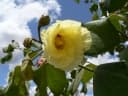
Thespesia garckeana
Thespesia garckeana
Safety & Hazards
None known
Cultivation Details
A plant of the tropics and subtropics, where it is found at elevations from around sea level up to about 2,000 metres[1]. It is found in areas where annual daytime annual temperatures fall within the range 15 - 30°c, but can tolerate 10 - 38°c[2]. Plants can withstand mild frosts, but can be killed at temperatures of -2°c[2]. It grows best where the mean annual rainfall is 250 - 750mm, but tolerates 200 - 1,250mm[1, 2]. Requires a sunny position[2]. Succeeds in various soil types, though it prefers light yellow-brown to reddish-yellow gritty, sandy clay loams, and is also often found on black to dark grey and brown clays.[2]. Established plants are drought resistant though they thrive with abundant water during the rainy season[2]. Prefers a pH in the range 5 - 7, tolerating 4.5 - 7.5[2]. A fast-growing species, plants can begin to produce fruit when only two years old from seed[1]. Trees respond well to coppicing and pollarding[3]. Trees often sucker freely in the wild[3].
Propagation
Seed - it can retain its viability for several years[1]. Normally the seed does not need pre-treatment but in some cases scarification, e.g. by nicking may be necessary[1]. The seeds can be sown in seedbeds or in containers. Direct sowing is also possible. Germination is very good and uniform without treatment. It reaches 40% after 15 days and 80% 20 days after sowing. 100% germination has been found after scarification[1]. Division of root suckers[3]. Cite as: Tropical Plants Database, Ken Fern. tropical.theferns.info. 2026-02-20. <tropical.theferns.info/viewtropical.php?id=Thespesia+garckeana>
Pollinators
Insects
References
- [1]Seed Leaflets — Various · Forest & Landscape. Denmark · http://en.sl.life.ku.dk/Publikationer/Udgivelser/PopulaerPublikationer.aspx?katid={D28373CC-6EF3-4EF8-B097-6D83FABF209E}&serieid={9F1C3DB1-6E7B-4CF1-AF53-F480B0CB40EF}&sort=title ↩︎A series of leaflets, jointly produced by the University of Copenhagen and the Royal Botanic Gardens at Kew, focussing on seed information for a number species, but also giving a lot of other information about each plant.
- [2]Ecocrop — http://ecocrop.fao.org/ecocrop/srv/en/home ↩︎Basic information on a wide range of useful plants, plus details of environmental needs where available.
- [3]Indigenous multipurpose trees of Tanzania. — Hines. D.A. & Eckman. K. · 1993 · ISBN 0-9697075-0-9 ↩︎A simple handbook with information on over 50 species of trees found in Tanzania giving details of environmental requirements, cultivation needs, uses etc. It can be downloaded from the Internet.
- [4]Annals of the Missouri Botanical Garden Vol. 65 — Missouri Botanical Garden · 1978 ↩︎An excellent botanical publication, available for download from the Internet. This volume contains parts of the Flora of Panama.
- [5]Frutipedia - Encyclopedia of Edible Fruits of the World — Parmar Dr. C. · http://fruitipedia.com/index.htm ↩︎An online publication, listing over 400 species of fruits, usually with photos and some information on the plant.
- [6]Cornucopia II — Facciola. S. · Kampong Publications, California. · 1998 · ISBN 0-9628087-2-5 ↩︎The second edition of an excellent guide to the edible uses of plants, though it does not give any details of cultivation etc.