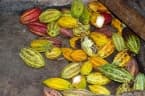
Theobroma cacao
Theobroma cacao
Safety & Hazards
Chocolate can cause allergies and migraine in some people[1].
Cultivation Details
A tree of the lowland tropics, usually found below 300 metres but occasionally found as high as 900 metres[2]. It succeeds where the mean annual temperature is in the range 18 - 28.5°c with a maximum temperature of 30 - 33.5°c and a minimum 13 - 18°c[2]. The absolute minimum is 10°c, below which trees are likely to suffer severe damage[2]. Rainfall should be plentiful and well distributed throughout the year[2]. An annual rainfall level of between 1,500 - 2,000mm is suitable, though it is reported to tolerate an annual precipitation of 480 - 4,300mm[2]. Requires a fertile, moisture-retentive but well-drained soil in sun or part shade in a position sheltered from the wind[3]. Prefers an acid soil[4]. Prefers a pH in the range 5 - 6.5, tolerating 4 - 8[5]. An understorey tree of the forest, it grows best in dappled shade[4], but can even produce well in quite dense shade[3]. There are three main types of cacao:- Criollo Cacaos originated in Central America. It is red skinned and the highest grade, but is low-yielding[4]. Trinitario Cacaos arose in Trinidad. It is high grade[4]. Forastero Cacaos comes from the Amazon Basin[4]. The insignificant flowers have a faint, sweet fragrance[3]. In favourable conditions both flowers and fruit will be borne throughout the year[3]. Freshly planted young trees are slow to establish and grow away, rarely growing more than 1.5 metres tall after 2 years[6]. Weeding and temporary shade are essential within the first 3 - 4 years of establishment before the canopy closes. Plantain appears to meet most of cocoa's requirements in this respect, whereas bananas compete heavily for moisture during the dry season[2]. There are some named varieties[7].
Propagation
Seed - loses its viability within 5 - 7 days from being separated from the pulp[3, 2]. Sow the seed as soon as it is ripe, in individual containers in a shaded position, covering them with about 5mm of potting compost[6]. The seeds readily germinate when sown fresh, and do not pass through a dormancy period. They usually germinate within 7 - 10 days[2]. Seedlings grow away slowly[6]. Air layering. Leaf-bud cutting. Grafting. Cite as: Tropical Plants Database, Ken Fern. tropical.theferns.info. 2026-02-20. <tropical.theferns.info/viewtropical.php?id=Theobroma+cacao>
Pollinators
Thrips, Midges, Ants, Aphids
References
- [1]Encyclopaedia of Herbs and their Uses. — Bown. D. · Dorling Kindersley, London. · 1995 · ISBN 0-7513-020-31 ↩︎A very well presented and informative book on herbs from around the globe. Plenty in it for both the casual reader and the serious student. Just one main quibble is the silly way of having two separate entries for each plant.
- [2]World Agroforesty Centre — http://www.worldagroforestry.org/ ↩︎An excellent online database of a huge range of trees giving very good information on each plant - its uses, ecology, identity, propagation, pests etc.
- [3]The New RHS Dictionary of Gardening. 1992. — Huxley. A. · MacMillan Press · 1992 · ISBN 0-333-47494-5 ↩︎Excellent and very comprehensive, though it contains a number of silly mistakes. Readable yet also very detailed.
- [4]Tropical and Subtropical Trees - A Worldwide Encyclopaedic Guide. — Barwick. M. · Thames & Hudson, London · 2004 · ISBN 0-500-51181-0 ↩︎A superb book, very concise and well written, giving a wealth of information on 400 or more species including descriptions, habitat, cultivation details and plant uses. A wealth of colour photographs bring each plant vividly to life.
- [5]Ecocrop — http://ecocrop.fao.org/ecocrop/srv/en/home ↩︎Basic information on a wide range of useful plants, plus details of environmental needs where available.
- [6]Brazilian Trees. Volume 1. 4th Edition. — Lorenzi. H. · Instituto Plantarum De Estudos Da Flora; Brazil. · 2002 · ISBN 85-86714-17-8 ↩︎Information on 350 species of Brazilian trees. Stunning photographs of each species, brief details on the plant, its uses and how to grow it from seed. A superb work, with the minor irritation that the translation from Portuguese is not of the best.
- [7]Cornucopia II — Facciola. S. · Kampong Publications, California. · 1998 · ISBN 0-9628087-2-5 ↩︎The second edition of an excellent guide to the edible uses of plants, though it does not give any details of cultivation etc.
- [8]Contributions from the United States National Herbarium Vol. 35 — Smithsonian Institution Press; Washington. · 1968 · http://www.biodiversitylibrary.org ↩︎A treatment of the genus Theobroma and a monograph of the Humiriaceae are two of the various articles contained in this issue. It can be downloaded from the Internet.
- [9]The Encyclopedia of Medicinal Plants — Chevallier. A. · Dorling Kindersley. London · 1996 · ISBN 9-780751-303148 ↩︎An excellent guide to over 500 of the more well known medicinal herbs from around the world.
- [10]Brazilian Fruits and Cultivated Exotics — Lorenzi. H.; Bacher. L.; Lacerda. M.; Sartori. S. · Instituto Plantarum De Estudos Da Flora LTDA; Brazil. · 2000 · ISBN 85-867174-24-0 ↩︎A superb book, giving information on several hundred fruit species. Each entry has a brief description of the plant and its uses, accompanied by one to many excellent quality photographs of the fruits.
- [11]Medicinal Plants of the Guianas — DeFilipps, R. A.; Maina, S. L.; & Crepin, J. · Smithsonian Museum · http://botany.si.edu/bdg/medicinal/index.html ↩︎A down-loadable PDF document of a book in pre-publication awaiting illustration. An excellent, if rather terse, guide to the traditional medicinal uses of the plants of the region
- [12]CosIng — http://ec.europa.eu/growth/tools-databases/cosing/ ↩︎CosIng is the European Commission database for information on cosmetic substances and ingredients.