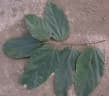
Theobroma bicolor
Theobroma bicolor
Safety & Hazards
None known
Cultivation Details
A plant of the moist tropics, where it is found at elevations up to 900 metres. The plant can also do well in upland tropical environments[1]. It grows best in areas where annual daytime temperatures are within the range 22 - 28°c, but can tolerate 10 - 35°c[2]. It prefers a mean annual rainfall in the range 1,500 - 2,000mm, but tolerates 1,100 - 2,500mm[2]. Grows in part-shade to full shade[3]. The plant prefers alluvial soils and tolerates minimal flooding[1]. Some forms seem to be adapted to deep and prolonged flooding[1]. Grows best in well-drained soil[3]. Prefers a pH in the range 5 - 6, tolerating 4.5 - 8.5[2]. The tree slowly increases in size as it ages, and can be very productive[1]. It coppices fairly well, and can produce fruit at times when other fruits are scarce[1].
Propagation
Seed - it has a very short viability, requiring high humidity and optimum temperatures to remain viable. There is no dormancy, the seed often germinating whilst still inside the pod[4]. Grafting is not very successful because the bark heals with difficulty[4]. Cite as: Tropical Plants Database, Ken Fern. tropical.theferns.info. 2026-02-20. <tropical.theferns.info/viewtropical.php?id=Theobroma+bicolor>
Pollinators
Insects, ?Wind
References
- [1]Rainforest Conservation Fund — http://www.rainforestconservation.org/data_sheets/agroforestry/index.html ↩︎Terse details on usage and Agroforestry notes, coupled with some good photos.
- [2]Ecocrop — http://ecocrop.fao.org/ecocrop/srv/en/home ↩︎Basic information on a wide range of useful plants, plus details of environmental needs where available.
- [3]Trade Winds Fruit — http://www.tradewindsfruit.com/index.htm ↩︎The on-line catalogue of a company selling seeds. Gives descriptions, photos and uses of a very wide range of fruit and other food-producing plants plus ornamentals.
- [4]Contributions from the United States National Herbarium Vol. 35 — Smithsonian Institution Press; Washington. · 1968 · http://www.biodiversitylibrary.org ↩︎A treatment of the genus Theobroma and a monograph of the Humiriaceae are two of the various articles contained in this issue. It can be downloaded from the Internet.
- [5]Mansfeld's Database of Agricultural and Horticultural Plants — http://mansfeld.ipk-gatersleben.de/pls/htmldb_pgrc/f?p=185:3:4292127278597336 ↩︎Terse details of a huge range of useful plants.
- [6]Perennial Edible Fruits of the Tropics : an Inventory — Martin, F. W.; Campbell, C. W.; Rubertbe, R. M. · U.S. Dept. of Agriculture, Agricultural Research Service · 1987 ↩︎A booklet giving terse details of almost 300 species of edible fruits, plus regional lists of Botanical and Common names for over 2,500 less well-known edible fruits of the tropics.
- [7]Flora of Guatemala — Standley P.C. & J. A. Steyermark · 1946 - 1976 · http://www.archive.org/ ↩︎A superb reference, though somewhat dated. Gives lots of plant uses as well as information on plant habit and habitat. The entire flora (13 volumes) can now be downloaded from http://www.archive.org/
- [8]Dictionary of Economic Plants. — Uphof. J. C. Th. · Weinheim · 1959 · ISBN - ↩︎An excellent and very comprehensive guide but it only gives very short descriptions of the uses without any details of how to utilize the plants. Not for the casual reader.
- [9]Encyclopaedia of Herbs and their Uses. — Bown. D. · Dorling Kindersley, London. · 1995 · ISBN 0-7513-020-31 ↩︎A very well presented and informative book on herbs from around the globe. Plenty in it for both the casual reader and the serious student. Just one main quibble is the silly way of having two separate entries for each plant.
- [10]The Encyclopedia of Medicinal Plants — Chevallier. A. · Dorling Kindersley. London · 1996 · ISBN 9-780751-303148 ↩︎An excellent guide to over 500 of the more well known medicinal herbs from around the world.