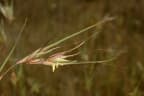
Themeda triandra
Themeda triandra
Cultivation Details
A very adaptable plant, found in a wide range of climates from continental temperate (where it grows as an annual), through subtropical to tropical, being found at elevations from near sea level to over 3,000 metres. It grows best in areas where annual daytime annual temperatures are within the range 22 - 28°c, though it can tolerate 15 - 35°c[2]. It prefers a mean annual rainfall in the range 500 - 1,100mm, but can tolerate 450 - 6,250mm[2]. Prefers a sunny position[2]. Succeeds in a wide range of soil types, but dislikes heavy clays[3]. Prefers a pH in the range 6.5 - 7, tolerating 5.5 - 7.5[2]. Established plants are drought tolerant[2]. Plants are fairly tolerant of fires, usually regrowing from the base if the top growth is burned down[2, 4]. A polymorphic species[1].
Propagation
Seed - there is some after-ripening dormancy and it takes approximately 12 months storage before the full germination potential of the seed is realized[5]. Dormancy results from a combination of embryo dormancy and mechanically resistant glumes. Successful germination of the spikelets entails the splitting of the tough upper glumes by radicles. Glume removal, plus treatment with gibberellic acid increases germination rates and reduces germination time[5]. Cite as: Tropical Plants Database, Ken Fern. tropical.theferns.info. 2026-02-20. <tropical.theferns.info/viewtropical.php?id=Themeda+triandra>
Pollinators
Wind
References
- [1]The Useful Plants of West Tropical Africa. — Burkil. H. M. · Royal Botanic Gardens; Kew. · 1985 - 2004 ↩︎Brief descriptions and details of the uses of over 4,000 plants. A superb, if terse, resource, it is also available electronically on the Web - see http://www.aluka.org/
- [2]Ecocrop — http://ecocrop.fao.org/ecocrop/srv/en/home ↩︎Basic information on a wide range of useful plants, plus details of environmental needs where available.
- [3]Plant Resources of Southeast Asia — http://proseanet.org/ ↩︎Lots of information on the uses of the plants of SE Asia.
- [4]A revision of Themeda (Gramineae) in Malesia with a new species from Laos — Veldkamp J.F. · 2016 · http://dx.doi.org/10.3767/000651916X691349 ↩︎
- [5]Grassland Species - Profiles — http://www.fao.org/ag/AGP/AGPC/doc/Gbase/Default.htm ↩︎Terse information on over 650 species of plants that grow in grassland, including trees, shrubs and perennial plants as well as grasses. Gives a brief description of the plant, its range and habitat and some of its uses.
- [6]Dictionary of Economic Plants. — Uphof. J. C. Th. · Weinheim · 1959 · ISBN - ↩︎An excellent and very comprehensive guide but it only gives very short descriptions of the uses without any details of how to utilize the plants. Not for the casual reader.