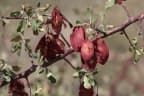
Terminalia prunioides
Terminalia prunioides
Safety & Hazards
None known
Cultivation Details
A plant of the drier tropics where it is found at elevations up to 1,400 metres. It grows best in areas where the mean maximum and minimum annual temperatures are within the range 20 - 35°c, though it can tolerate 15 - 40°c[1]. It is only found wild in frost-free areas[1]. It prefers a mean annual rainfall in the range 450 - 900mm, though can tolerate from 400 - 1,000mm[1]. Grows best in a sunny position[1]. Succeeds in most well-drained soils of at least moderate fertility[1]. The tree is sometimes found wild on saline soils[1]. Prefers a pH in the range 6 - 8, tolerating 5.5 - 8.5[1]. The flowers have a strong and unpleasant smell. Each inflorescence contains bisexual and male flowers, male flowers towards the apex, bisexual flowers towards the base[2, 1].
Propagation
Seed - viability can be maintained for at least 1 year in hermetic storage at 3°c[2]. Cite as: Tropical Plants Database, Ken Fern. tropical.theferns.info. 2026-02-20. <tropical.theferns.info/viewtropical.php?id=Terminalia+prunioides>
Pollinators
Insects
References
- [1]Ecocrop — http://ecocrop.fao.org/ecocrop/srv/en/home ↩︎Basic information on a wide range of useful plants, plus details of environmental needs where available.
- [2]World Agroforesty Centre — http://www.worldagroforestry.org/ ↩︎An excellent online database of a huge range of trees giving very good information on each plant - its uses, ecology, identity, propagation, pests etc.
- [3]Gemsbok Bean and Kalahari Truffle — Leffers A. · Gamsberg MacMillan; Namibia. · 2003 · ISBN 99916-0-491-X ↩︎Details of the traditional uses of over 200 species of plants in northeastern Namibia. Written for the non-expert, there is usually at least one photograph with each plant entry.
- [4]Protabase - Plant Resources of Tropical Africa. — http://www.prota.org ↩︎An excellent on-line database with detailed information on over 3,200 species of useful plants of Africa.