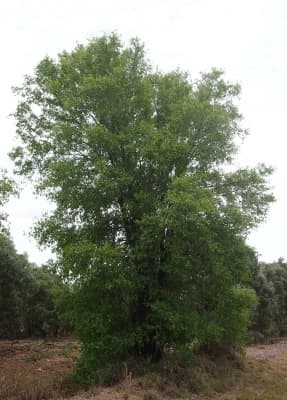
Terminalia oblongata
Terminalia oblongata
Safety & Hazards
New leaves may be poisoning for livestock due to the presence of oxalates[1].
Cultivation Details
A plant of the semiarid to moist tropics, where it can be found at elevations up to 300 metres[2]. It grows best in areas where the mean maximum and minimum annual temperatures are within the range 22 - 38°c, though it can tolerate 12 - 44°c[2]. It prefers a mean annual rainfall in the range 600 - 850mm, though can tolerate from 400 - 950mm[2]. Prefers a sunny position[2]. The tree grows wild in sandy soils, brown-red skeletal soils, cracking clay, grey sand over sandstone, basalt[3]. It succeeds in most soils, even those of low fertility[2]. Prefers a pH in the range 5 - 6, tolerating 4.5 - 6.5[2].
Propagation
Seed - Cite as: Tropical Plants Database, Ken Fern. tropical.theferns.info. 2026-02-20. <tropical.theferns.info/viewtropical.php?id=Terminalia+oblongata>
Pollinators
Data unavailable
References
- [1]Annals of the Missouri Botanical Garden Vol. 65 — Missouri Botanical Garden · 1978 ↩︎An excellent botanical publication, available for download from the Internet. This volume contains parts of the Flora of Panama.
- [2]Ecocrop — http://ecocrop.fao.org/ecocrop/srv/en/home ↩︎Basic information on a wide range of useful plants, plus details of environmental needs where available.
- [3]Florabase — https://florabase.dpaw.wa.gov.au/ ↩︎An excellent on-line database of Western Australian plants
- [4]Flora of Australia — http://www.anbg.gov.au/abrs/abif/flora/ ↩︎The full information from the Flora of Australia - on-line. An excellent resource.
- [5]The Useful Native Plants of Australia. — Maiden J.H. · Turner & Co.; London. · 1889 · http://www.biodiversitylibrary.org ↩︎Terse details of the uses of many Australian plants and other species naturalised, or at least growing, in Australia. It can be downloaded from the Internet.