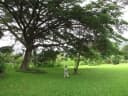
Terminalia microcarpa
Terminalia microcarpa
Safety & Hazards
None known
Cultivation Details
A plant of the tropical lowlands, where it can be found at elevations up to 750 metres[1]. It grows best in areas where the mean maximum and minimum annual temperatures are within the range 22 - 38°c, though it can tolerate 12 - 45°c[1]. It prefers a mean annual rainfall in the range 850 - 1,900mm, though can tolerate from 600 - 2,100mm[1]. It is found in monsoon forests, where there is a distinct dry season[2]. Requires a sunny position[1]. Plants are tolerant of shade[3]. Prefers a well-drained, medium to light soil[1]. Prefers a pH in the range 5.5 - 6.5, tolerating 4.5 - 7[1]. The fruit is usually harvested when it falls to the ground[2].
Propagation
Seed - Cite as: Tropical Plants Database, Ken Fern. tropical.theferns.info. 2026-02-20. <tropical.theferns.info/viewtropical.php?id=Terminalia+microcarpa>
Pollinators
Data unavailable
References
- [1]Ecocrop — http://ecocrop.fao.org/ecocrop/srv/en/home ↩︎Basic information on a wide range of useful plants, plus details of environmental needs where available.
- [2]Food Plants of Papua New Guinea — French. B.R. · Author. · 2006 ↩︎Published on-line in PDF format, this book contains information on several hundred New Guinea food plants.
- [3]Forest Types and Products; The Principal Forest Trees — Whitford H.N. · Bureau of Forestry; Manilla · 1911 · http://www.biodiversitylibrary.org ↩︎A series of booklets dealing with various aspects of the Philippine forests. This volume gives a brief description of the main timber species in the Philippines . It can be downloaded from the Internet.
- [4]Perennial Edible Fruits of the Tropics : an Inventory — Martin, F. W.; Campbell, C. W.; Rubertbe, R. M. · U.S. Dept. of Agriculture, Agricultural Research Service · 1987 ↩︎A booklet giving terse details of almost 300 species of edible fruits, plus regional lists of Botanical and Common names for over 2,500 less well-known edible fruits of the tropics.
- [5]Flora Malesiana Series 1 — Various · Nationaal Herbarium Nederiand, Universiteit Leiden branch · http://www.archive.org ↩︎A massive treatment of the plants of the Malaysian Archipelago. Much of it has been made available to download from the Internet
- [6]Asean Tropical Plant Database — http://211.114.21.20/tropicalplant/index.jsp ↩︎Terse details, with photos, of many of the plants growing in the tropical forests of southeast Asia. Gives some details of plant uses along with a description of the plant and its range.
- [7]Commercial Woods of the Philippines; Their Preparation and Uses — Schneider E.E. · Bureau of Forestry; Manilla. · 1916 · http://www.biodiversitylibrary.org ↩︎A series of booklets dealing with various aspects of the Philippine forests. This volume looks at the preparation and uses of the commercial woods of the Philippines. It can be downloaded from the Internet.
- [8]Mansfeld's Database of Agricultural and Horticultural Plants — http://mansfeld.ipk-gatersleben.de/pls/htmldb_pgrc/f?p=185:3:4292127278597336 ↩︎Terse details of a huge range of useful plants.
- [9]Florabase — https://florabase.dpaw.wa.gov.au/ ↩︎An excellent on-line database of Western Australian plants
- [10]Medicinal Plants of the Philippines — Bureau of Plant Industry, Philippines. · http://www.bpi.da.gov.ph/Publications/mp/mplants.html ↩︎An Internet site from the Philippines Department of Agriculture, giving information in a readable way on the medicinal uses of many plants in their area.
- [11]Flora of Australia — http://www.anbg.gov.au/abrs/abif/flora/ ↩︎The full information from the Flora of Australia - on-line. An excellent resource.
- [12]Minor Products of Philippine Forests — Brown. W. H. · Bureau of Forestry, Manilla. · 1920 ↩︎A useful guide to some of the plants of the area, though terse on details. The book is out of copyright and can be legally downloaded from the Internet.
- [13]The Useful Native Plants of Australia. — Maiden J.H. · Turner & Co.; London. · 1889 · http://www.biodiversitylibrary.org ↩︎Terse details of the uses of many Australian plants and other species naturalised, or at least growing, in Australia. It can be downloaded from the Internet.