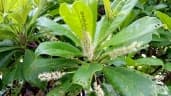
Cultivation Details
A plant of the moist tropics, where it is found at elevations from sea level to 1,200 metres[4]. It grows in areas where the mean annual temperature is in the range 20 - 33°c and the mean annual rainfall is 1,250 - 3,000 mm[4]. It prefers climates with a dry season, but is also found in areas with year-round rainfall[4]. For optimum development, it requires high, well-distributed rainfall[4]. Requires a sunny position[4]. The most suitable soils are lateritic loams, well-drained loams, sandy loams, clay loams and volcanic soils[4]. The plant can withstand short periods of inundation, though it is usually sensitive to waterlogging[4]. Prefers a pH in the range 5.5 - 6.5, tolerating 4.5 - 7.5[5]. A fast-growing tree. In medium-sized to large gaps in the forest, young trees may reach a height of 17 metres with a bole 25cm in diameter just 8 years after germination[6]. Planted trees in Côte d’Ivoire were generally 2.9 - 4.9 metres tall after 20 months, with exceptional growth up to 9 metres in some plants[6]. Trees 22 years old reached 36.5 metres with a bole diameter of 75cm[6]. Height growth is most rapid in the first 10 years of the tree's life, and decreases steadily afterwards, whereas mean annual wood volume increment reaches a peak of 15.5 cubic metres per hectare after 10 years, steadily decreasing to 6.9 cubic metres 51 years after planting[6]. The very fast rate of growth, straight stem and self-pruning habit, even at an early stage, make this an ideal species for the creation of large-scale, even-aged plantations[4]. The tree coppices well, even to an advanced age, but it is normally managed on a coppice rotation[4, 3]. The tree is naturally not long-lived, and in old age the heart-wood becomes inferior, hollow or brittle[3]. Cultivation should ensure felling at the optimum age[3]. The rotation applied in favourable locations in Africa is 40 years[4]. The tree forms a good taproot supported by 6 - 8 powerful lateral roots[4]. There is also evidence of a widespread and rather superficial root system[4]. Plants are very vulnerable to fire[4]. Selection and breeding started in the 1960s in Africa. Since then, trees with superior growth rate and stem form have been selected, and clone banks have been established[4].
Propagation
Seed - best soaked overnight in cold water and then sown the following day[4]. Partial scarification of the seed coat will also aid germination[4]. Pre-treatment can also be by alternate soaking and drying for 1 week[4]. The seed germinates better if it is covered by the soil to exclude light[4]. Germination rate is usually 10 - 50%, but up to 93% has been achieved under experimental temperature fluctuations[4]. Light shade is generally applied during germination, but it should be removed after 1 - 2 months[4]. Adequate moisture during germination is a prerequisite[4]. Germination usually starts within 2 weeks of sowing and lasts for another 2 - 5 weeks[4]. The Seedlings rapidly develop a taproot and so should be potted up into containers as soon as they are large enough to handle[4]. Seedlings are ready for planting when they are 20 - 30 cm tall[4]. Seeds can also be sown in situ[4]. Orthodox seed storage behaviour; seeds maintained viability at 8.6% mc. Seeds can be stored in room temperature for up to 3 or 4 months. If stored in airtight containers at temperatures of 5 to -5 deg. C, they can be stored for up to 1 year. Can also be stored as dry fruit[4]. Cite as: Tropical Plants Database, Ken Fern. tropical.theferns.info. 2026-02-20. <tropical.theferns.info/viewtropical.php?id=Terminalia+ivorensis>
Pollinators
Butterflies, Flies
References
- [1]Tropical Timbers of the World. Ag. Handbook No. 607. — Chudnoff. Martin. · USDA Forest Service. Wisconsin. · 1984 ↩︎Terse details on the properties of the wood of almost 400 species of trees from the Tropics.
- [2]BoDD (Botanical Dermatology Database) — http://bodd.cf.ac.uk/ ↩︎Brief notes on a very wide range of plants that have reports of causing harm to the skin.
- [3]The Useful Plants of West Tropical Africa. — Burkil. H. M. · Royal Botanic Gardens; Kew. · 1985 - 2004 ↩︎Brief descriptions and details of the uses of over 4,000 plants. A superb, if terse, resource, it is also available electronically on the Web - see http://www.aluka.org/
- [4]World Agroforesty Centre — http://www.worldagroforestry.org/ ↩︎An excellent online database of a huge range of trees giving very good information on each plant - its uses, ecology, identity, propagation, pests etc.
- [5]Brazilian Trees. Volume 1. 4th Edition. — Lorenzi. H. · Instituto Plantarum De Estudos Da Flora; Brazil. · 2002 · ISBN 85-86714-17-8 ↩︎Information on 350 species of Brazilian trees. Stunning photographs of each species, brief details on the plant, its uses and how to grow it from seed. A superb work, with the minor irritation that the translation from Portuguese is not of the best.
- [6]Protabase - Plant Resources of Tropical Africa. — http://www.prota.org ↩︎An excellent on-line database with detailed information on over 3,200 species of useful plants of Africa.
- [7]Mansfeld's Database of Agricultural and Horticultural Plants — http://mansfeld.ipk-gatersleben.de/pls/htmldb_pgrc/f?p=185:3:4292127278597336 ↩︎Terse details of a huge range of useful plants.
- [8]IUCN Red List of Threatened Species — http://www.iucnredlist.org/ ↩︎A list of plants under threat and facing possible extinction, usually with brief details of the threats and information on habitat.
- [9]Tropix 7 — CIRAD · http://tropix.cirad.fr/en ↩︎An on-line guide to the timbers of 245 species of trees.