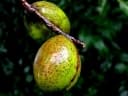
Terminalia chebula
Terminalia chebula
Safety & Hazards
None known
Cultivation Details
Succeeds in tropical and subtropical areas up to an elevation of 1,500 metres, exceptionally to 2,000 metres[1]. It grows best in areas where the mean maximum and minimum annual temperatures are within the range 22 - 35°c, though it can tolerate 5 - 47°c[2]. Plants are fairly tolerant to frost, but are killed by temperatures below -5°c[1, 2]. It prefers a mean annual rainfall in the range 1,000 - 1,700mm, though can tolerate from 750 - 3,300mm[2]. Prefers a sunny position, but younger plants tolerate some shade[3, 1]. Succeeds in any moderately fertile, well-drained soil from sandy to clayey[4, 3]. Established plants are fairly drought tolerant[1]. Prefers a pH in the range 5.5 - 6.5, but tolerates 5 - 7.5[2]. Growth rates of seedlings and young trees is quite slow[3]. Regrows well after burning and also after coppicing, producing new shoots 2 - 3 metres long after 5 years[3, 1]. Regeneration of natural stands from seed is usually poor, maybe because people harvest the fruit, but also because of predation by animals[3]. Yields of up to 10 kilos of fruit per tree per year can be obtained from trees growing wild[3].
Propagation
The fallen fruits are collected and dried thoroughly first. Later the hardened flesh is removed Fermentation of the stones gives the best germination results, but clipping the broad end of the stone without damaging the embryo, followed by soaking in cold water for 36 hours gives good results too[1]. The seed is usually sown in a nursery bed or containers, direct sowing is not advisable because of the risk of predation and because the seeds germinate poorly[1]. The germination rate of the seed is up to 50%[1]. Early growth is comparatively slow, with seedlings 10 - 20cm tall by the end of the first season and 25 - 50cm tall by the end of the second season[3]. Cuttings[1]. Cite as: Tropical Plants Database, Ken Fern. tropical.theferns.info. 2026-02-20. <tropical.theferns.info/viewtropical.php?id=Terminalia+chebula>
Pollinators
Data unavailable
References
- [1]World Agroforesty Centre — http://www.worldagroforestry.org/ ↩︎An excellent online database of a huge range of trees giving very good information on each plant - its uses, ecology, identity, propagation, pests etc.
- [2]Ecocrop — http://ecocrop.fao.org/ecocrop/srv/en/home ↩︎Basic information on a wide range of useful plants, plus details of environmental needs where available.
- [3]Protabase - Plant Resources of Tropical Africa. — http://www.prota.org ↩︎An excellent on-line database with detailed information on over 3,200 species of useful plants of Africa.
- [4]The New RHS Dictionary of Gardening. 1992. — Huxley. A. · MacMillan Press · 1992 · ISBN 0-333-47494-5 ↩︎Excellent and very comprehensive, though it contains a number of silly mistakes. Readable yet also very detailed.
- [5]Cornucopia II — Facciola. S. · Kampong Publications, California. · 1998 · ISBN 0-9628087-2-5 ↩︎The second edition of an excellent guide to the edible uses of plants, though it does not give any details of cultivation etc.
- [6]Encyclopaedia of Herbs and their Uses. — Bown. D. · Dorling Kindersley, London. · 1995 · ISBN 0-7513-020-31 ↩︎A very well presented and informative book on herbs from around the globe. Plenty in it for both the casual reader and the serious student. Just one main quibble is the silly way of having two separate entries for each plant.
- [7]The Encyclopedia of Medicinal Plants — Chevallier. A. · Dorling Kindersley. London · 1996 · ISBN 9-780751-303148 ↩︎An excellent guide to over 500 of the more well known medicinal herbs from around the world.
- [8]Plants and People of Nepal — Manandhar. N. P. · Timber Press. Oregon. · 2002 · ISBN 0-88192-527-6 ↩︎Excellent book, covering over 1,500 species of useful plants from Nepal together with information on the geography and peoples of Nepal. Good descriptions of the plants with terse notes on their uses.
- [9]A Manual of Indian Timbers. — Gamble. J. S. · Bishen Singh Mahendra Pal Singh · 1972 · ISBN - ↩︎First written in the 19th century, but still a classic, giving a lot of information on the uses and habitats of Indian trees. Not for the casual reader.
- [10]Digital Compendium of Forestry Species of Cambodia — www.digitalspecies.blogspot.com; Phnom Penh · 2008 · http://www.digitalspecies.blogspot.com ↩︎A very detailed booklet, produced in PDF format on the internet, giving information on around 100 species of trees.