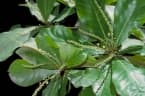
Terminalia catappa
Terminalia catappa
Safety & Hazards
Various species of biting and stinging ants have been found inhabiting hollow twigs on this tree[1].
Cultivation Details
Plants grow best in the lowland tropics at elevations below 800 metres[2]. It grows best in areas where the mean maximum and minimum annual temperatures are within the range 21 - 32°c, though it can tolerate 10 - 36°c[3]. It prefers a mean annual rainfall in the range 1,500 - 3,400mm, though can tolerate from 700 - 4,200mm[3]. Succeeds in any moderately fertile, well-drained soil in a sunny position[4]. Prefers sands and loamy sands, though it also does well on silts, loam, and even clays if the drainage is good[2]. Tolerates saline soils[5]. Prefers soil that are neutral to moderately alkaline and rich in bases, however it will also grow in strongly acid soils[2]. A particularly useful plant for coastal gardens, being tolerant of salt spray[4, 2]. Established plants are drought tolerant[2]. Prefers a pH in the range 5 - 7, but tolerates 4.3 - 8[3]. Plants are fast growing, often in excess of 1 metre a year when young[2]. Trees can yield two crops a year in some areas, and in places have been known to exhibit more or less continuous fruiting[5]. A tree may yield around 5 kg of kernels per year[5]. There has been some selection in cultivating forms with larger seeds[6]. The tree sheds its leaves all at once, quite suddenly, usually twice a year (January or February and July or August). Unlike most tropical trees, the leaves turn first yellow, then vivid red before falling, giving a well-marked 'autumn colour'[6]. The inconspicuous flowers have a sweet, delicate fragrance[4]. Various species of biting and stinging ants have been found inhabiting hollow twigs on this tree[1].
Propagation
Seed - pre-soak for 24 hours in cold water[2]. About 70% of ripe seed germinate in about 20 days[2]. Seeds remain viable for a long time and germinate readily, even after floating in water for long distances[2]. Cite as: Tropical Plants Database, Ken Fern. tropical.theferns.info. 2026-02-20. <tropical.theferns.info/viewtropical.php?id=Terminalia+catappa>
Pollinators
Insects
References
- [1]BoDD (Botanical Dermatology Database) — http://bodd.cf.ac.uk/ ↩︎Brief notes on a very wide range of plants that have reports of causing harm to the skin.
- [2]World Agroforesty Centre — http://www.worldagroforestry.org/ ↩︎An excellent online database of a huge range of trees giving very good information on each plant - its uses, ecology, identity, propagation, pests etc.
- [3]Ecocrop — http://ecocrop.fao.org/ecocrop/srv/en/home ↩︎Basic information on a wide range of useful plants, plus details of environmental needs where available.
- [4]The New RHS Dictionary of Gardening. 1992. — Huxley. A. · MacMillan Press · 1992 · ISBN 0-333-47494-5 ↩︎Excellent and very comprehensive, though it contains a number of silly mistakes. Readable yet also very detailed.
- [5]Edible Nuts. — Wickens G.E. · FAO, Rome. · 1995 · http://www.fao.org/docrep/ · ISBN 92-5-103748-5 ↩︎Detailed information on 20 of the most valuable nut crops, plus more basic information on a wide range of other nut-producing plants. It can be downloaded from the Internet.
- [6]Flora Malesiana Series 1 — Various · Nationaal Herbarium Nederiand, Universiteit Leiden branch · http://www.archive.org ↩︎A massive treatment of the plants of the Malaysian Archipelago. Much of it has been made available to download from the Internet
- [7]Food Plants of Papua New Guinea — French. B.R. · Author. · 2006 ↩︎Published on-line in PDF format, this book contains information on several hundred New Guinea food plants.
- [8]Tropical and Subtropical Trees - A Worldwide Encyclopaedic Guide. — Barwick. M. · Thames & Hudson, London · 2004 · ISBN 0-500-51181-0 ↩︎A superb book, very concise and well written, giving a wealth of information on 400 or more species including descriptions, habitat, cultivation details and plant uses. A wealth of colour photographs bring each plant vividly to life.
- [9]Nuts. — Howes. F. N. · Faber · 1948 · ISBN - ↩︎Rather old but still a masterpiece. Has sections on tropical and temperate plants with edible nuts plus a section on nut plants in Britain. Very readable.
- [10]Mansfeld's Database of Agricultural and Horticultural Plants — http://mansfeld.ipk-gatersleben.de/pls/htmldb_pgrc/f?p=185:3:4292127278597336 ↩︎Terse details of a huge range of useful plants.
- [11]South Pacific Indigenous Nuts. ACIAR Proceedings No 69 — Stevens M.L.; Bourke R.M. & Evans B.R. · Australian Centre for International Agricultural Research; Canbe · 1996 · ISBN 1 86320 175 0 ↩︎Proceedings of a workshop held from 31 October to 4 November 1994 at Le Lagon Resort, Port Vila, Vanuatu.
- [12]Plants of Southeast Asia — http://www.asianplant.net/ ↩︎Excellent site with brief information on the plant, its range, habitat and uses, plus phots of specimens, close-ops of flowers and leaves etc,
- [13]Dictionary of Economic Plants. — Uphof. J. C. Th. · Weinheim · 1959 · ISBN - ↩︎An excellent and very comprehensive guide but it only gives very short descriptions of the uses without any details of how to utilize the plants. Not for the casual reader.
- [14]Cornucopia II — Facciola. S. · Kampong Publications, California. · 1998 · ISBN 0-9628087-2-5 ↩︎The second edition of an excellent guide to the edible uses of plants, though it does not give any details of cultivation etc.
- [15]Minor Products of Philippine Forests — Brown. W. H. · Bureau of Forestry, Manilla. · 1920 ↩︎A useful guide to some of the plants of the area, though terse on details. The book is out of copyright and can be legally downloaded from the Internet.
- [16]The Useful Plants of the Island of Guam — Safford W.E. · Smithsonian Institute; Washington. · 1905 · http://www.biodiversitylibrary.org/ ↩︎A very comprehensive, if rather dated, guide to the plants of Guam. It can be downloaded from the Internet.
- [17]Medicinal Plants in the South Pacific — WHO Regional Publications, Manilla. · 1998 · ISBN 92-9061-118-9 ↩︎Excellent guide to 102 medicinal herbs of the Pacific Islands, with photographs of each plant and details of their constituents, biological activities and traditional uses. A description of each plant, together with habitat and distribution is given.
- [18]Medicinal Plants of the Philippines — Bureau of Plant Industry, Philippines. · http://www.bpi.da.gov.ph/Publications/mp/mplants.html ↩︎An Internet site from the Philippines Department of Agriculture, giving information in a readable way on the medicinal uses of many plants in their area.
- [19]A Manual of Indian Timbers. — Gamble. J. S. · Bishen Singh Mahendra Pal Singh · 1972 · ISBN - ↩︎First written in the 19th century, but still a classic, giving a lot of information on the uses and habitats of Indian trees. Not for the casual reader.
- [20]Commercial Woods of the Philippines; Their Preparation and Uses — Schneider E.E. · Bureau of Forestry; Manilla. · 1916 · http://www.biodiversitylibrary.org ↩︎A series of booklets dealing with various aspects of the Philippine forests. This volume looks at the preparation and uses of the commercial woods of the Philippines. It can be downloaded from the Internet.