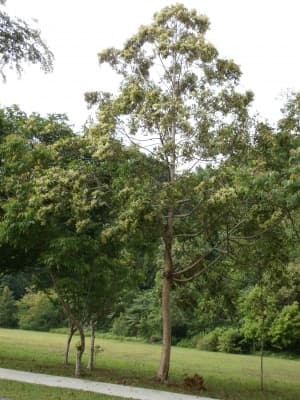
Terminalia brassii
Terminalia brassii
Safety & Hazards
None known
Cultivation Details
A plant of wet, lowland tropical areas, where it is found at elevations up to 600 metres[1]. It grows best in areas where annual daytime annual temperatures are within the range 28 - 34°c, though it can tolerate 20 - 38°c[1]. It prefers a mean annual rainfall of 3,000 - 4,000mm, but tolerates 2,000 - 5,000mm[1]. Requires a sunny position, though young trees are more tolerant of shade[1]. Grows best in a deep, medium to heavy soil[1]. Tolerates wet soils and anaerobic soil conditions[2, 1]. Prefers a pH in the range 4.5 - 5.5, but tolerates 4 - 6.5[1]. Seedlings can withstand violent flooding and often establish themselves beside rivers that can overflow their banks[1, 3]. The rotation applied for pulpwood production in the Solomon Islands is 10 - 11 years and for sawlog production it is estimated at 20 years[2]. Young trees often send out stiff, horizontal adventitious roots high above the ground[4]. The bark comes off in long, loose strips so that the general appearance is reminiscent of some species of Eucalyptus or Tristania[4].
Propagation
Seed - best sown in containers since transplanting from a nursery bed is not very successful[2]. It is a pioneer species, requiring plenty of light at the time of establishment[1]. Dried seed, with a moisture content of 5%, can be stored for a prolonged period at temperatures under -20°c[2]. Cuttings[2]. Grafting[2]. Cite as: Tropical Plants Database, Ken Fern. tropical.theferns.info. 2026-02-20. <tropical.theferns.info/viewtropical.php?id=Terminalia+brassii>
Pollinators
Data unavailable
References
- [1]Ecocrop — http://ecocrop.fao.org/ecocrop/srv/en/home ↩︎Basic information on a wide range of useful plants, plus details of environmental needs where available.
- [2]World Agroforesty Centre — http://www.worldagroforestry.org/ ↩︎An excellent online database of a huge range of trees giving very good information on each plant - its uses, ecology, identity, propagation, pests etc.
- [3]Handbooks of the Flora of Papua New Guinea — Womersley. J.S. (Editor) · Melbourne University Press · 1995 · ISBN 0 522 84095 7 ↩︎Only a part of the flora, but an excellent publication in 3 volumes. It can be downloaded from the internet.
- [4]Flora Malesiana Series 1 — Various · Nationaal Herbarium Nederiand, Universiteit Leiden branch · http://www.archive.org ↩︎A massive treatment of the plants of the Malaysian Archipelago. Much of it has been made available to download from the Internet
- [5]Guide to the Trees of Papua New Guinea — Conn. B.J. & Damas. K.Q. · http://www.pngplants.org/PNGtrees/ ↩︎An Internet site giving good descriptions of the trees of Papua New Guinea.