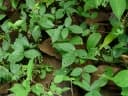
Teramnus labialis
Teramnus labialis
Safety & Hazards
None known
Cultivation Details
A plant of the moist tropics, where it is found at elevations from sea level up to 3,000 metres. It grows best in areas where annual daytime temperatures are within the range 17 - 27°c, but can tolerate 10 - 36°c[1]. When dormant, the plant can survive temperatures down to about -3°c, but young growth can be severely damaged at -1°c[1]. It prefers a mean annual rainfall in the range 750 - 1,500mm, but tolerates 500 - 2,500mm[1]. Succeeds in full sun and in light shade[1]. Tolerates a wide range of moist, fertile soils[1]. Prefers a pH in the range 6 - 8, tolerating 5 - 9[1]. Established plants are relatively drought tolerant[1].
Propagation
Generally, the seed does not require scarification. However, levels of hard seed can be high, and scarification may be necessary in some instances to achieve at least 50% germination[2]. This can usually be done by pouring a small amount of nearly boiling water on the seeds (being careful not to cook them!) and then soaking them for 12 - 24 hours in warm water. By this time they should have imbibed moisture and swollen - if they have not, then carefully make a nick in the seedcoat (being careful not to damage the embryo) and soak for a further 12 hours before sowing[PFAF]. The seed can be broadcast or sown at 2 - 3 kilos per hectare in rows 50 - 75cm apart, and no more than 3 cm deep. Seed is small and seedling development relatively slow, so seed should be sown into a well-prepared seedbed, with the area rolled after sowing. Stands take 6 - 8 months to become established[2]. Although this species appears somewhat promiscuous in relation to rhizobial requirements, inoculation with CB 756 (Australia) or an equivalent strain may be beneficial[2]. Cite as: Tropical Plants Database, Ken Fern. tropical.theferns.info. 2026-02-20. <tropical.theferns.info/viewtropical.php?id=Teramnus+labialis>
Pollinators
Data unavailable
References
- [1]Ecocrop — http://ecocrop.fao.org/ecocrop/srv/en/home ↩︎Basic information on a wide range of useful plants, plus details of environmental needs where available.
- [2]Tropical Forages — http://www.tropicalforages.info/key/Forages/Media/Html/index.htm ↩︎Mainly focussed on forage plants, the site gives a lot of information on the plant, with a good botanical description, details of cultivation, plant uses and a good selection of photographs.
- [3]Genetic Resources of Under-exploited Legumes/Tribal Pulses of Western Ghats, Tamil Nadu — Kalidass C. & Mohan V.R. · 2011 ↩︎
- [PFAF]Plants for a Future — pfaf.org ↩︎