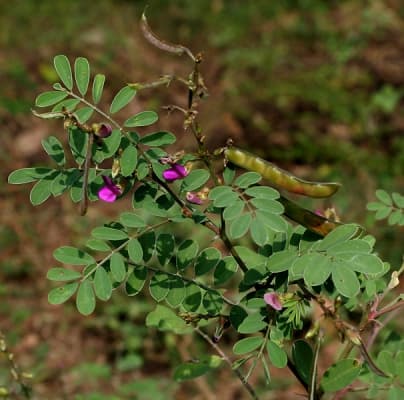
Tephrosia purpurea
Tephrosia purpurea
Safety & Hazards
The plant contains the rotenoid tephrosine, which stuns fish but not mammals[1]. The pounded leaves are used to stupefy and catch fish[2, 1]. The plant contains rotenonoids and has been used traditionally as a fish poison - rotenoids kill or stun the fish making them easy to catch, but the fish remain perfectly edible for mammals. Rotenonoids are classified by the World Health Organization as moderately hazardous. They are mildly toxic to humans and other mammals, but extremely toxic to many insects (hence their use as an insecticide) and aquatic life, including fish. This higher toxicity in fish and insects is because the lipophilic rotenonoid is easily taken up through the gills or trachea, but not as easily through the skin or the gastrointestinal tract. The lowest lethal dose for a child is 143 mg/kg, but human deaths from rotenone poisoning are rare because its irritating action causes vomiting. Deliberate ingestion of rotenone, however, can be fatal. The compound decomposes when exposed to sunlight and usually has an activity of six days in the environment.
Cultivation Details
A plant of the lowland tropics, where it is usually found at elevations up to 400 metres, occasionally as high as 1,300 metres[2]. Prefers dry, gravelly or rocky and sandy soils, but in Madras (India) it grows well on loamy soils[2]. It is tolerant of saline-sodic soil conditions[2]. The plant flowers throughout the year in Java[2]. A deep rooted plant[3]. T. Purpurea is associated with the vesicular-arbuscular mycorrhizal fungi Glomus heterosporum and Sclerocystis microcarpus in waste sites of coal mines and calcite mine spoils, and is nodulated by Rhizobium[2]. Its growth is often not very luxuriant, limiting its value as a temporary shade crop or green manure. When added to the soil as green manure it increases humus content and induces the formation of large, stable soil aggregates. It produces ample seed and builds up a large seedbank in the soil[2]. This species has a symbiotic relationship with certain soil bacteria, these bacteria form nodules on the roots and fix atmospheric nitrogen. Some of this nitrogen is utilized by the growing plant but some can also be used by other plants growing nearby[4].
Propagation
Seed - easy[2]. Cite as: Tropical Plants Database, Ken Fern. tropical.theferns.info. 2026-02-20. <tropical.theferns.info/viewtropical.php?id=Tephrosia+purpurea>
Pollinators
Data unavailable
References
- [1]Hawaiian Ethnobotany Online Database — http://www2.bishopmuseum.org/ethnobotanydb/index.asp ↩︎Brief details on over 100 species of Hawaiian plants.
- [2]World Agroforesty Centre — http://www.worldagroforestry.org/ ↩︎An excellent online database of a huge range of trees giving very good information on each plant - its uses, ecology, identity, propagation, pests etc.
- [3]Grassland Species - Profiles — http://www.fao.org/ag/AGP/AGPC/doc/Gbase/Default.htm ↩︎Terse information on over 650 species of plants that grow in grassland, including trees, shrubs and perennial plants as well as grasses. Gives a brief description of the plant, its range and habitat and some of its uses.
- [4]The New RHS Dictionary of Gardening. 1992. — Huxley. A. · MacMillan Press · 1992 · ISBN 0-333-47494-5 ↩︎Excellent and very comprehensive, though it contains a number of silly mistakes. Readable yet also very detailed.
- [5]Cornucopia II — Facciola. S. · Kampong Publications, California. · 1998 · ISBN 0-9628087-2-5 ↩︎The second edition of an excellent guide to the edible uses of plants, though it does not give any details of cultivation etc.
- [6]The American Barbistyled Species of Tephrosia (Leguminosae) — Wood C.E. · 1949 ↩︎