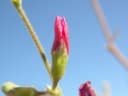
Tephrosia lupinifolia
Tephrosia lupinifolia
Safety & Hazards
None known
Cultivation Details
Requires a sunny position[1]. Found in the wild on poor, sandy soils[1]. The plant has a deep penetrating tap-root[1]. In addition to the normal flowers produced above ground, the plant also sometimes produces shorter axillary pseudoracemes near the base of the stem - these push underground in sandy soil and bear small pale cleistogamous flowers and short 1 - 2-seeded pods[2]. This species has a symbiotic relationship with certain soil bacteria; these bacteria form nodules on the roots and fix atmospheric nitrogen. Some of this nitrogen is utilized by the growing plant but some can also be used by other plants growing nearby[3].
Propagation
Seed - Cite as: Tropical Plants Database, Ken Fern. tropical.theferns.info. 2026-02-20. <tropical.theferns.info/viewtropical.php?id=Tephrosia+lupinifolia>
Pollinators
Data unavailable
References
- [1]The Useful Plants of West Tropical Africa. — Burkil. H. M. · Royal Botanic Gardens; Kew. · 1985 - 2004 ↩︎Brief descriptions and details of the uses of over 4,000 plants. A superb, if terse, resource, it is also available electronically on the Web - see http://www.aluka.org/
- [2]Flora of Tropical East Africa — Beentje H.J. · Royal Botanic Gardens; Kew. · 2002 · http://plants.jstor.org/search?st=396814 ↩︎Available on-line, a modern flora of East Africa.
- [3]Nodulation Plants in GRIN Taxonomy — United States Department of Agriculture · http://www.ars-grin.gov/~sbmljw/cgi-bin/taxnodul.pl?language=en ↩︎An online database listing plants that have either positive or negative reports on root and stem nodulation with nitrogen-fixing bacteria.
- [4]African Flowering Plants Database — Conservatoire et Jardin Botaniques. · http://www.ville-ge.ch/musinfo/bd/cjb/africa/recherche.php ↩︎Contains information on over 150,000 plant names (including synonyms) giving a description and habitat, plus a distribution map.
- [5]Flora Capensis — Hiern. W.P.; Brown N.E. · 1909 · http://www.aluka.org/action/doBrowse?sa=1&st=662543&execbr=&sls= ↩︎Rather dated, and many of the botanical names have been changed since it was written, but contains a wealth of information about plants of southern Africa. It can be downloaded or viewed online.
- [6]Gemsbok Bean and Kalahari Truffle — Leffers A. · Gamsberg MacMillan; Namibia. · 2003 · ISBN 99916-0-491-X ↩︎Details of the traditional uses of over 200 species of plants in northeastern Namibia. Written for the non-expert, there is usually at least one photograph with each plant entry.
- [7]Cataloge of African Plants Collected by Dr. Friedrich Welwitsch in 1853 - 1861 — Hiern. W.P. · Longmans & Co.; London. · 1898 · http://www.biodiversitylibrary.org ↩︎In 6 volumes, it gives botanical descriptions and some uses of the plants. It can be downloaded from the Internet.