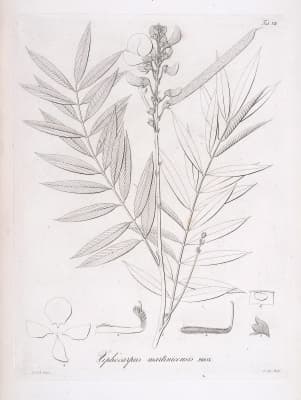
Tephrosia candida
Tephrosia candida
Safety & Hazards
There are unconfirmed reports of the bark and roots being used as a fish poison[1]. Powdered leaves are used as an insecticide and the bark and roots are used as fish poison in India[2]. The plant contains rotenonoids and has been used traditionally as a fish poison - rotenoids kill or stun the fish making them easy to catch, but the fish remain perfectly edible for mammals. Rotenonoids are classified by the World Health Organization as moderately hazardous. They are mildly toxic to humans and other mammals, but extremely toxic to many insects (hence their use as an insecticide) and aquatic life, including fish. This higher toxicity in fish and insects is because the lipophilic rotenonoid is easily taken up through the gills or trachea, but not as easily through the skin or the gastrointestinal tract. The lowest lethal dose for a child is 143 mg/kg, but human deaths from rotenone poisoning are rare because its irritating action causes vomiting. Deliberate ingestion of rotenone, however, can be fatal. The compound decomposes when exposed to sunlight and usually has an activity of six days in the environment.
Cultivation Details
A plant of the seasonally dry tropics, where it is found at elevations up to 1,650 metres. It grows best in areas where annual daytime temperatures are within the range 20 - 30°c, but can tolerate 14 - 34°c[2]. It does not tolerate frost[1]. It prefers a mean annual rainfall in the range 1,400 - 1,800mm, but tolerates 700 - 2,700mm[2]. Prefers a sunny position, tolerating light shade[2]. Grows well on sandy soils in coastal areas and on very poor, eroded upland soils and mine spoils where few other crops can grow[1]. Plants are intolerant of waterlogged soils[1]. Prefers a pH in the range 4.5 - 6.5, tolerating 3.5 - 7.5[2]. The more acidic soils seem to be more suitable[1]. Established plants are drought tolerant[3]. Tephrosia candida is a drought-tolerant, nitrogen-fixing shrub that is commonly used in agroforestry systems, especially for soil improvement and erosion control. It is also used as a green manure and in extended fallows, contour hedgerows, and as a shade and nurse tree. It has been widely introduced to many tropical regions for these purposes. Although now widespread, it is only reported as invasive in a few countries, including parts of China (Hong Kong and Hunan), Taiwan, Reunion and a few Pacific islands (Hawaii, Cook Islands, Samoa, Palau and Micronesia). It has the ability to form dense thickets, especially in disturbed areas, the resulting monocultures reducing the growth of native species[3] White tephrosia is a deep rooting and can be slow to establish, but it grows steadily once established[1]. Maximum growth normally takes place in the 2nd year after planting, but with regular pruning a dense cover can be maintained for many years[1]. Annual biomass yields of about 12 - 18 tonnes per hectare can be obtained when the plant is grown with cassava, whilst 20 - 40 tonnes or more can be obtained when grown on its own[1]. Flowering times vary considerably - in Malaysia it flowers all year round, but it only flowers for 2 months of the year in Vietnam[1]. Over-mature pods will shatter and lose their seeds[1]. This species has a symbiotic relationship with certain soil bacteria, these bacteria form nodules on the roots and fix atmospheric nitrogen. Some of this nitrogen is utilized by the growing plant but some can also be used by other plants growing nearby[4].
Propagation
Seed - soak the seed for 4 - 5 hours in warm water prior to sowing[1]. It should be sown just before or during the rainy season. The germination rate of fresh seed is 95 - 100%, but viability decreases rapidly unless seeds are stored in a cool, dry place[1]. When broadcasting, a planting density of 50 000-60 000/ha is aimed at, requiring 15-20 kg seed[1]. Seed storage behaviour is orthodox. No loss in viability following 3 years in either open storage or hermetic storage at room temperature with 13% ± 2% mc. There are between 300 and 500 seeds/kg[1]. Cite as: Tropical Plants Database, Ken Fern. tropical.theferns.info. 2026-02-20. <tropical.theferns.info/viewtropical.php?id=Tephrosia+candida>
Pollinators
Insects
References
- [1]World Agroforesty Centre — http://www.worldagroforestry.org/ ↩︎An excellent online database of a huge range of trees giving very good information on each plant - its uses, ecology, identity, propagation, pests etc.
- [2]Ecocrop — http://ecocrop.fao.org/ecocrop/srv/en/home ↩︎Basic information on a wide range of useful plants, plus details of environmental needs where available.
- [3]Invasive Species Compendium — http://www.cabi.org ↩︎An immense resource - in depth information on over 900 species of invasive plants (it also has information on animals, fungi etc).
- [4]The New RHS Dictionary of Gardening. 1992. — Huxley. A. · MacMillan Press · 1992 · ISBN 0-333-47494-5 ↩︎Excellent and very comprehensive, though it contains a number of silly mistakes. Readable yet also very detailed.
- [5]The American Barbistyled Species of Tephrosia (Leguminosae) — Wood C.E. · 1949 ↩︎