Telfairia pedata
Telfairia pedata
Safety & Hazards
None known
Cultivation Details
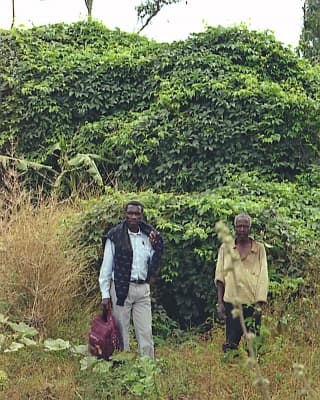
Oysternut grows best in lowland, humid tropical areas at elevations up to 1,000 metres[1]. It can be cultivated at elevations up to 1,800 metres, though yields start to fall the more the elevation increases above 1,000 metres. It grows best in areas where annual daytime temperatures are within the range 23 - 28°c, but can tolerate 14 - 38°c[2]. It prefers a mean annual rainfall in the range 1,500 - 2,000mm, but tolerates 1,200 - 2,500mm[2]. Succeeds in full sun and in light shade[2]. Tolerant of a wide range of well-drained soils[3, 1], though a humus-rich, fertile soil gives the best yields[1]. Prefers a pH in the range 5.5 - 6, tolerating 5 - 7[2]. Plants produce a deep taproot and, once established, are very drought resistant[4, 3, 1]. Plants are often trained to grow into trees[1]. They greatly dislike exposure to strong or cold winds[4]. This species has high weed potential[3]. Young plants grow very quickly, producing stems up to 7 metres long in 6 months and 15 metres long in 18 months[5]. Flowering normally commences 15 - 18 months after planting out the young plants[6]. Female and male plants cannot be distinguished until they flower[5]. The fruit takes 5 - 6 months to ripen from flowering[6]. When fruits ripen they split open gradually. To attain full flavour, the seeds should be allowed to ripen in the fruit and be collected 7 - 10 days after the fruit begins to split[5]. The plant produces up to 30 gourds in its third year and can continue production for another 20 years[5, 6]. Under good conditions, two harvests per year are possible, and flowers and fruits can be present at the same time[5]. Annual seed yields of 3 - 7 tonnes per hectare have been achieved[4, 5]. The fruits burst when ripe, scattering the seeds[4]. Care must be taken when growing these plants to choose sufficiently large trees for them to grow into, since their weight, especially when bearing a crop of fruits, can be enormous[4]. A dioecious plant, both male and female forms must be grown if seed is required[4]. Generally 12 - 15 males per hectare are sufficient to fertilise a plantation of females[4]. There are reports that female plants can produce fruit and seed in the absence of a male plant by a process called apomixis[5].
Propagation
Seed - it has a short viability and is best sown as soon as ripe. Repeated soaking and drying promotes germination[5]. The seed can be sown in situ or in containers[1]. The drip line of trees is a favoured site for planting in situ[5]. When grown in containers, sow 2 - 3 seeds in each container thinning to the strongest plant once they germinate. The seed usually germinates in 7 - 14 days[6]. Seedlings grow away quickly and are ready for planting out about 30 days after germinating[1]. Layering. Very easy[4]. Cuttings. Stemcuttings root in 2 - 3 weeks, and produce shoots 6 - 7 weeks after planting[5]. Cite as: Tropical Plants Database, Ken Fern. tropical.theferns.info. 2026-02-20. <tropical.theferns.info/viewtropical.php?id=Telfairia+pedata>
Pollinators
Insects
References
- [1]Vegetables in the Tropics — Tindall. H. D. · MacMillan, Oxford. · 1983 · ISBN 0-333-24268-8 ↩︎An excellent, in-depth look at the main vegetable crops that can be grown in the Tropics, plus many less well-known plants.
- [2]Ecocrop — http://ecocrop.fao.org/ecocrop/srv/en/home ↩︎Basic information on a wide range of useful plants, plus details of environmental needs where available.
- [3]Edible Leaves of the Tropics — Martin. F. W.; Ruberte. R. M. & Meitzner. L. S. · Echo. USA. · 1998 · ISBN 0-9653360-1-8 ↩︎A terse guide, giving reasonable detail on the more common leaf crops and brief information on a wide range of lesser known plants.
- [4]Nuts. — Howes. F. N. · Faber · 1948 · ISBN - ↩︎Rather old but still a masterpiece. Has sections on tropical and temperate plants with edible nuts plus a section on nut plants in Britain. Very readable.
- [5]Protabase - Plant Resources of Tropical Africa. — http://www.prota.org ↩︎An excellent on-line database with detailed information on over 3,200 species of useful plants of Africa.
- [6]World Agroforesty Centre — http://www.worldagroforestry.org/ ↩︎An excellent online database of a huge range of trees giving very good information on each plant - its uses, ecology, identity, propagation, pests etc.
- [7]Flora Zambesiaca — http://apps.kew.org/efloras/fz/intro.html ↩︎An excellent online flora of plants from the Zambezi River basin. It lists a number of the plant uses as well as the habitats and botanical descriptions of the plants.
- [8]Dictionary of Economic Plants. — Uphof. J. C. Th. · Weinheim · 1959 · ISBN - ↩︎An excellent and very comprehensive guide but it only gives very short descriptions of the uses without any details of how to utilize the plants. Not for the casual reader.