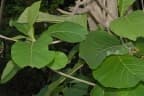
Tectona grandis
Tectona grandis
Safety & Hazards
The fine dust produced in machining operations may cause irritation of the skin or bronchial asthma and rhinitis after inhalation; a well-functioning dust extractor fan is recommended. The substance responsible for the allergic reaction is probably the naphthoquinone desoxylapachol[1].
Cultivation Details
A plant of the tropics, where it is found at elevations from sea level to 1,200 metres[2]. It is able to survive and grow under a wide range of climatic and edaphic conditions, but grows best in a warm, moist, tropical climate with a significant difference between dry and wet seasons[2]. It is found in areas where the mean annual temperature is in the range 14 - 36°c[2]. The tree can be killed by temperatures falling down to 3°c[3]. It prefers a mean annual rainfall: of 1,200 - 2,500mm, but is able to succeed with as little as 600mm, or as much as 4,000mm[2]. Requires a sunny position[2]. The most suitable soil is deep, well-drained, fertile alluvial-colluvial soil with a pH of 6.5 - 8 and a relatively high calcium and phosphorous content[2]. Prefers a pH in the range 6 - 7.5, tolerating 4.5 - 8.5[3]. The quality of growth, however, depends on the depth, drainage, moisture status and the fertility of the soil. Teak does not tolerate waterlogging or infertile lateritic soils[2]. Initial growth of the tree is rapid[2]. At an age of 5 years, an average height of 13 metres with a bole diameter of 10cm is not unusual; after 10 years, 16.5 metres and 15 cm; after 20 years, 21.5 metres and 23.5 cm. After 15 or 20 years, growth slows down. In stands of 80-year-old trees, maximum height is about 45 metres, with a maximum diameter of 75 cm[2]. The rotation period is approximately 80 years[2]. The height of the tree at the moment of first flowering is important in silviculture. When it is long (it may reach up to 10 metres), the final bole form is positively affected, but early-flowering trees may develop extremely wide crowns and short boles. This characteristic is clearly undesirable in timber-crop species and warrants strong selection against flowering in conjunction with increased effort to develop commercial methods of vegetative propagation. The time of the 1st inflorescence is determined by both genetic and environmental factors[2]. In Thailand, flowering normally starts at the age of 8 to 10 years. However, trees have been observed to flower at the age of 3 months, while a few specimens of superior phenotype did not flower until the age of 27 years[2]. Flowers usually appear during the rainy season, and trees tend to flower synchronously[2]. For plantations, stumps are planted at a spacing of 2 x 2 metres[2]. As the tree is deciduous, raising pure plantations is discouraged; rather, it is recommended to raise 80% of mixed indigenous species and the remaining 20% teak. The average plantation yield in Java is 60 - 100 cubic metres/ha, including thinning. Occasionally the final harvest may yield as much as 390 cubic metres/ha in stands 80 years old[2]. The mean annual volume increment is (min. 1) 3-6 (max. 15) cubic metres/ha[2]. The root system is superficial, often no deeper than 50 cm, but the roots may extend laterally up to 15 metres from the stem[2]. Young plants show a remarkable capability to recover after fire[2].
Propagation
Seed - fresh seed is more difficult to germinate than seed that has been stored for 12 months[2]. If it is necessary to use fruits from the same year they were collected, then they should be subjected to alternate wetting then drying for 24 hours each for 14 days[2]. Stored seed germinates best if soaked for 24 - 48 hours in warm water, prior to sowing, changing the water frequently[2]. Another method of encouraging germination is to char (or half burn) the fruits by covering them with a thin layer of grass and lighting it[2]. The germination rate is low, usually less than 50%, but sometimes up to 80%[2]. Germination usually starts after 10 days but may take 2 - 3 months[2]. Seedlings should be given a little shade for their first year and can then be planted into their permanent positions[2]. Natural regeneration is particularly abundant in forests exposed to fires and often occurs in patches. Seeds collected from the forest floor are generally used to establish plantations. It is recommended that seeds be collected from trees over 20 years old. Seed is often collected from selected stands. Fruit that has lain dormant in the ground for 30 - 40 years has been known to germinate abundantly[2]. Both grafting and budding methods showed better results than branch cutting methods. The rooting time of cutting is 8 - 15 days, and the survival rate of rooted stock is 90 - 100%[2]. Cite as: Tropical Plants Database, Ken Fern. tropical.theferns.info. 2026-02-20. <tropical.theferns.info/viewtropical.php?id=Tectona+grandis>
Pollinators
Bees, Flies, Ants
References
- [1]Protabase - Plant Resources of Tropical Africa. — http://www.prota.org ↩︎An excellent on-line database with detailed information on over 3,200 species of useful plants of Africa.
- [2]World Agroforesty Centre — http://www.worldagroforestry.org/ ↩︎An excellent online database of a huge range of trees giving very good information on each plant - its uses, ecology, identity, propagation, pests etc.
- [3]Ecocrop — http://ecocrop.fao.org/ecocrop/srv/en/home ↩︎Basic information on a wide range of useful plants, plus details of environmental needs where available.
- [4]Cornucopia II — Facciola. S. · Kampong Publications, California. · 1998 · ISBN 0-9628087-2-5 ↩︎The second edition of an excellent guide to the edible uses of plants, though it does not give any details of cultivation etc.
- [5]Digital Compendium of Forestry Species of Cambodia — www.digitalspecies.blogspot.com; Phnom Penh · 2008 · http://www.digitalspecies.blogspot.com ↩︎A very detailed booklet, produced in PDF format on the internet, giving information on around 100 species of trees.