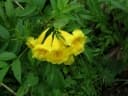
Tecoma stans
Tecoma stans
Safety & Hazards
None known
Cultivation Details
Tecoma stans is a plant of drier areas in the tropics and subtropics, it can be found at elevations from sea level to around 2,000 metres[1]. It grows best in areas where annual daytime temperatures are within the range 15 - 25°c, but can tolerate 10 - 35°c[2]. The plant is intolerant of frost[1]. It prefers a mean annual rainfall in the range 500 - 700mm, but tolerates 400 - 800mm[2]. Trees can perform well in areas of less than the recommended rainfall but need to be irrigated; they can also grow at higher altitudes than recommended, but they are then said to be slow in flowering[1]. Requires a sunny position[1]. Prefers clay loams, but tolerates most types of fertile, well-drained soils and is particularly tolerant of alkaline conditions[3]. Prefers a pH in the range 6 - 8.5, tolerating 5.5 - 9[2]. Established plants are drought tolerant[1]. The plant has escaped from cultivation and become naturalised in some areas[4]. It is capable of forming dense thickets and crowding out native species[4]. Plants can flower all year round[1]. The flower buds pop when squeezed[5].
Propagation
Seed - does not require pre-treatment[1]. The seed, which germinates easily, can be sown in nursery beds or in containers[1]. Seedlings require 3 - 4 months in the nursery, after which they can be directly planted out[1]. Seed storage behaviour is orthodox, and seeds can be stored for long periods under ideal conditions[1]. Regeneration by cuttings is also possible[1]. Cite as: Tropical Plants Database, Ken Fern. tropical.theferns.info. 2026-02-20. <tropical.theferns.info/viewtropical.php?id=Tecoma+stans>
Pollinators
Bees
References
- [1]World Agroforesty Centre — http://www.worldagroforestry.org/ ↩︎An excellent online database of a huge range of trees giving very good information on each plant - its uses, ecology, identity, propagation, pests etc.
- [2]Ecocrop — http://ecocrop.fao.org/ecocrop/srv/en/home ↩︎Basic information on a wide range of useful plants, plus details of environmental needs where available.
- [3]Mansfeld's Database of Agricultural and Horticultural Plants — http://mansfeld.ipk-gatersleben.de/pls/htmldb_pgrc/f?p=185:3:4292127278597336 ↩︎Terse details of a huge range of useful plants.
- [4]Global Invasive Species Database — http://www.issg.org/database/welcome/ ↩︎Very detailed information on almost 400 species (with more being added) of plants that have become weeds in areas outside their native range.
- [5]Common Trees of Puerto Rico and the Virgin Islands — Little E.L.; Wadsworth F.H. · USDA, Forest Service; Washington. · 1964 ↩︎Contains detailed information, and usually an illustration, on 250 tree species, including both native and exotic species.
- [6]Trees and Shrubs of Mexico — Standley P.C. · Smithsonian Institution; Washington · 1926 ↩︎Although dated, it contains a wealth of information on the trees and shrubs of Mexico, including many of their uses. It can be downloaded from the Internet.
- [7]Enciclopedia de las Plantas Útiles del Ecuador — de la Torre, L., Navarrete H., P. Muriel M., Macía M.J. & Ba · Herbario QCA de la Escuela de Ciencias Biológicas de la Pontific · 2008 · ISBN 978-9978-77-135-8 ↩︎