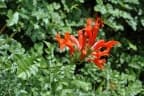
Tecoma capensis
Tecoma capensis
Safety & Hazards
None known
Cultivation Details
A plant of the subtropics to the tropics, where it can be found at elevations up to 1,200 metres. It is found in areas where the mean annual rainfall is in the range 750 - 1,750 mm, and the mean annual temperature is within the range 22 - 26°c[1]. Mature plants can tolerate light frosts, quickly recovering from minor damage, but young plants are frost tender and should be protected during its first two cold seasons[1, 2]. Succeeds in full sun and in semi-shade[1]. Grows in a variety of soils types[1]. Prefers a well-drained, fertile soil with a pH of 5.5 - 6.5[3]. Fairly tolerant of salt-laden winds, it can be grown near the coast[2]. The plant has been reported to occasionally escape from cultivation and naturalize in tropical America, but this has not been confirmed[3]. The plant grows fast, usually flowering in the second year[1]. It sometimes flowers all year round[4]. The plant can be coppiced or pruned in order to maintain its shape and to enhance flowering[1, 2]. A dioecious species, both male and female forms need to be grown if fruit and seed are required[1].
Propagation
Seed - Cuttings of young wood. Cuttings of half-ripe wood. Layering. The branches often root where they touch the ground[3]/ Cite as: Tropical Plants Database, Ken Fern. tropical.theferns.info. 2026-02-20. <tropical.theferns.info/viewtropical.php?id=Tecoma+capensis>
Pollinators
Insects, Birds
References
- [1]World Agroforesty Centre — http://www.worldagroforestry.org/ ↩︎An excellent online database of a huge range of trees giving very good information on each plant - its uses, ecology, identity, propagation, pests etc.
- [2]Desert Tropicals — http://www.desert-tropicals.com/ ↩︎The main focus of the site is succulent plants, but it also contains information on a wide range of other species. Usually at least one good photograph, plus basic information about the plant and its cultivation.
- [3]Pacific Island Ecosystems at Risk — http://www.hear.org/pier/scientificnames/index.html ↩︎A very good website detailing weed species that have been introduced into the Pacific Islands.
- [4]Flowers of India — http://www.flowersofindia.net/ ↩︎A wed site of native Indian plants, plus cultivated and naturalized species. It has good quality photos and terse details on more than 3,000 species and cultivars.
- [5]African Flowering Plants Database — Conservatoire et Jardin Botaniques. · http://www.ville-ge.ch/musinfo/bd/cjb/africa/recherche.php ↩︎Contains information on over 150,000 plant names (including synonyms) giving a description and habitat, plus a distribution map.