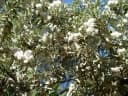
Tarchonanthus camphoratus
Tarchonanthus camphoratus
Safety & Hazards
None known
Cultivation Details
A plant mainly of the drier tropics and subtropics, it is found at elevations from around sea level to 2,750 metres[1]. It grows best in areas where annual daytime temperatures are within the range 17 - 33°c, but can tolerate 8 - 38°c[2]. When dormant, the plant can survive temperatures down to about -2°c, but young growth can be severely damaged at -1°c[2]. It prefers a mean annual rainfall in the range 300 - 600mm, but tolerates 150 - 800mm[2]. Requires a sunny position[2]. Tolerant of a range of soils, preferring deep soils but also commonly found on stony soils in the wild[1, 2]. Prefers a pH in the range 5.5 - 6.5, tolerating 5 - 7[2]. The plant is drought tolerant, and can also withstand seasonal waterlogging[1]. Plants are tolerant of salt-laden winds[3]. In its natural range the wild camphor bush is an invasive colonizer[1]. The plant is drought hardy, highly resistant to burning and cutting and can become a troublesome weed[2]. The plant has a moderate growth rate of around 600 - 800mm/year[1]. Young plants transplant easily[3]. The tree responds well to coppicing, which is an important management practice[1]. The leaves have a strong smell of camphor[3]. A dioecious species, both male and female forms need to be grown if seed is required[1].
Propagation
Seed - traditionally, it is sown in situ[1]. The seed takes about 56 days to germinate[1]. Wild collected seedlings are transplanted into gardens[1]. Cuttings of young wood[1]. These cuttings usually require rooting hormone to help them root[1]. Cite as: Tropical Plants Database, Ken Fern. tropical.theferns.info. 2026-02-20. <tropical.theferns.info/viewtropical.php?id=Tarchonanthus+camphoratus>
Pollinators
Data unavailable
References
- [1]World Agroforesty Centre — http://www.worldagroforestry.org/ ↩︎An excellent online database of a huge range of trees giving very good information on each plant - its uses, ecology, identity, propagation, pests etc.
- [2]Ecocrop — http://ecocrop.fao.org/ecocrop/srv/en/home ↩︎Basic information on a wide range of useful plants, plus details of environmental needs where available.
- [3]PlantZAfrica.com — http://www.plantzafrica.com ↩︎An excellent site giving detailed descriptions and uses of many S. African plants.
- [4]Dictionary of Economic Plants. — Uphof. J. C. Th. · Weinheim · 1959 · ISBN - ↩︎An excellent and very comprehensive guide but it only gives very short descriptions of the uses without any details of how to utilize the plants. Not for the casual reader.
- [5]Cornucopia II — Facciola. S. · Kampong Publications, California. · 1998 · ISBN 0-9628087-2-5 ↩︎The second edition of an excellent guide to the edible uses of plants, though it does not give any details of cultivation etc.
- [6]Silva Capensis — Pappe L. · Ward & Co.; London. · 1862 · http://www.biodiversitylibrary.org ↩︎A work on the useful trees and shrubs of S. Africa, written in 1862. Mainly looking at ways of exploiting the plants, but also deals with some traditional uses. It can be downloaded from the Internet.
- [7]Report on the Natal Forests — Fourcade H.G. · Wm. ;, Natal · 1889 · http://www.biodiversitylibrary.org ↩︎Contains a list of the trees of Natal, with a brief listing of their uses, including many traditional uses. The report can be downloaded from the Internet.
- [8]Useful Trees and Shrubs in Eritrea — Bein. E.; Habte. B.; Jaber. A.; Birnie. A. & Tengnas. B. · Regional Soil Conservation Unit: Nairobi · 1996 · ISBN 9966-896-24-4 ↩︎A very well written and concise guide to almost 200 species. It gives a brief description of each plant together with its habitat, uses, propagation and cultivation. Line drawings of each plant are also included It can be downloaded from the internet