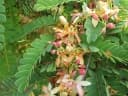
Tamarindus indica
Tamarindus indica
Safety & Hazards
None known
Cultivation Details
Tamarind grows best in drier areas of the tropics, though it can also do well in much wetter, monsoon areas so long as there is a distinct dry season. It is found at elevations up to 1,500 metres[1, 2, 3, 4]. It grows best in areas where annual daytime temperatures are within the range 20 - 35°c, but can tolerate 12 - 45°c[3]. When dormant, the plant can survive temperatures down to about -3°c, but young growth can be severely damaged at -1°c[3]. The plant is very sensitive to frost[2]. It prefers a mean annual rainfall in the range 800 - 3,000mm, but tolerates 300 - 4,500mm[3]. In India, it is not grown commercially in areas receiving more than 1,900mm of rain a year and in the wet tropics, with over 4,000 mm of rain, flowering and fruit setting is significantly reduced[2]. Regardless of total annual rainfall, a long, well-marked dry season is necessary for fruiting[5]. Plants succeed in a range of soils, though they prefer a well-drained, fertile soil in a sunny position[6, 7]. Often found near the coast and in sandy soils, which suggests it is tolerant of saline conditions[1]. Prefers a pH in the range 5.5 - 6.5, tolerating 4.5 - 8.5[3]. Plants have an extensive root system, which makes them very tolerant of windy conditions (including salt-laden winds) and drought[8, 5, 7]. Growth is generally slow; seedling height increasing by about 60cm annually[5]. Trees commence bearing fruit at 7 - 10 years of age, with maximum yields being obtained from about 15 years onwards[5]. Trees can continue yielding for 200 years[2, 4]. Yields of 200 kilos per tree have been recorded[8]. There are many named forms[1]. The trees respond to coppicing and pollarding[5]. This species has a symbiotic relationship with certain soil bacteria, these bacteria form nodules on the roots and fix atmospheric nitrogen. Some of this nitrogen is utilized by the growing plant but some can also be used by other plants growing nearby[8].
Propagation
Seed - when dried, it retains viability for several years at ambient temperatures[2]. Pre-soak the seed for 24 hours in warm water and sow in a nursery seedbed or containers at 21°c[8]. About 90% germination is achieved in 40 - 50 days[5]. Germination is best when seeds are covered by 1.5 cm loose, sandy loam or by a mixture of loam and sand[5]. The seedlings quickly develop a taproot and so should not be allowed to grow in a nursery seedbed for more than 4 months before being transplanted into containers[2]. Seedlings should attain at least 80 cm before being transplanted to their final location at the beginning of the rainy season[5]. They can be planted out when 30cm tall[2]. Cuttings of greenwood Air layering Grafting. Cite as: Tropical Plants Database, Ken Fern. tropical.theferns.info. 2026-02-20. <tropical.theferns.info/viewtropical.php?id=Tamarindus+indica>
Pollinators
Insects
References
- [1]Edible Leaves of the Tropics — Martin. F. W.; Ruberte. R. M. & Meitzner. L. S. · Echo. USA. · 1998 · ISBN 0-9653360-1-8 ↩︎A terse guide, giving reasonable detail on the more common leaf crops and brief information on a wide range of lesser known plants.
- [2]Seed Leaflets — Various · Forest & Landscape. Denmark · http://en.sl.life.ku.dk/Publikationer/Udgivelser/PopulaerPublikationer.aspx?katid={D28373CC-6EF3-4EF8-B097-6D83FABF209E}&serieid={9F1C3DB1-6E7B-4CF1-AF53-F480B0CB40EF}&sort=title ↩︎A series of leaflets, jointly produced by the University of Copenhagen and the Royal Botanic Gardens at Kew, focussing on seed information for a number species, but also giving a lot of other information about each plant.
- [3]Ecocrop — http://ecocrop.fao.org/ecocrop/srv/en/home ↩︎Basic information on a wide range of useful plants, plus details of environmental needs where available.
- [4]Trees and Shrubs of the Sahel. Their Characteristics and Uses. — von Maydell H. · Deutsche Gesellschaft fur Technische Zusammenarbeit; Germany · 1990 · ISBN 3-8236-1198-4 ↩︎A well-researched book, usually with more than one photograph of each species and good information on the plant and its uses.
- [5]World Agroforesty Centre — http://www.worldagroforestry.org/ ↩︎An excellent online database of a huge range of trees giving very good information on each plant - its uses, ecology, identity, propagation, pests etc.
- [6]Tropical Ornamentals; A Guide — Whistler. W. Arthur. · Timber Press Inc. Oregon. · 2000 · ISBN 0-88192-448-2 ↩︎An excellent little guide to some of the more commonly cultivated ornamental plants of the Tropics, often giving some information on the plants other uses.
- [7]Tropical and Subtropical Trees - A Worldwide Encyclopaedic Guide. — Barwick. M. · Thames & Hudson, London · 2004 · ISBN 0-500-51181-0 ↩︎A superb book, very concise and well written, giving a wealth of information on 400 or more species including descriptions, habitat, cultivation details and plant uses. A wealth of colour photographs bring each plant vividly to life.
- [8]The New RHS Dictionary of Gardening. 1992. — Huxley. A. · MacMillan Press · 1992 · ISBN 0-333-47494-5 ↩︎Excellent and very comprehensive, though it contains a number of silly mistakes. Readable yet also very detailed.
- [9]IUCN Red List of Threatened Species — http://www.iucnredlist.org/ ↩︎A list of plants under threat and facing possible extinction, usually with brief details of the threats and information on habitat.
- [10]Edible Wild Plants of Tanzania — Ruffo, C.K.: Birnie, A. & Tengnas, B. · Regional Land Management Unit; Nairobi. · 2002 · ISBN 9966-896-60-0 ↩︎A very well presented, simple guide to growing and utilizing wild food plants in Tanzania, with line drawings of each plant, a description, habitat and range, non-food as well as food uses, plus basic information on growing the plants.
- [11]Tropical Food Gardens — Norrington. L. · Bloomings Books (Melbourne) · 2001 · ISBN 1-876473-41-x ↩︎Excellent little book giving some basic information on a range of plants.
- [12]Cornucopia II — Facciola. S. · Kampong Publications, California. · 1998 · ISBN 0-9628087-2-5 ↩︎The second edition of an excellent guide to the edible uses of plants, though it does not give any details of cultivation etc.
- [13]Medicinal Plants of the Guianas — DeFilipps, R. A.; Maina, S. L.; & Crepin, J. · Smithsonian Museum · http://botany.si.edu/bdg/medicinal/index.html ↩︎A down-loadable PDF document of a book in pre-publication awaiting illustration. An excellent, if rather terse, guide to the traditional medicinal uses of the plants of the region
- [14]Trees of Laos and Vietnam - A Field Guide to 100 species. — Hoang Van Sam; Khamseng Nanthavong; Kessler P.J.A. · Blumea · 2004 ↩︎A detailed guide, with excellent line-drawings, to 100 of the more important trees of Laos and Vietnam. A very good work, giving lots of information about each plant. Originally published in the journal Blumea, it is available as a PDF on the Interne