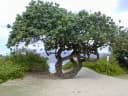
Talipariti tiliaceum
Talipariti tiliaceum
Safety & Hazards
None known
Cultivation Details
Talipariti tiliaceum is a tropical plant that is usually found in coastal and low elevation habitats, but can be found at elevations up to 800 metres[1]. It prefers a mean annual rainfall of 900 to 2,500mm with a mean maximum temperature 24 - 41°c and a mean minimum temperature of 5 - 24°c[1]. Prefers a moist but well-drained, humus-rich, fertile soil in a sunny position[2, 3, 4]. Succeeds in poor soils[1]. The plant is ideally suited to coastal locations and is highly tolerant of salt wind and salty soils[3, 1, 4]. Established plants are drought tolerant[4]. The plant has, in the past, been recorded as a pernicious weed in New Zealand, but has now been controlled there. There are also other reports of the plant becoming a weed, but these are more liley to refer to other taxa. It is listed as a potential weed in Florida[5]. The plant coppices readily and, when cut back, produces many long, vigorous shoots with a high fibre production[1]. Plants can flower and fruit all year round unless there is a dry season[6]. A shallow-rooted species, it is prone to being wind-blown when grown in a windy position, the branches quickly producing new roots from which develop new plants. In this way the plant can form dense thickets over large areas, especially where the trees are growing in soft mud[1, 4]. This habit of regeneration can be common especially after cyclones[1].
Propagation
Seed - sow in situ or in containers. Germination is usually quite rapid. Prick out container-grown seedlings into individual pots when they are large enough to handle and plant them out into their permanent positions when they are 10cm or more tall. Cuttings of half-ripe wood in a frame. Large limbs can be planted as living posts and usually root easily[4]. Cite as: Tropical Plants Database, Ken Fern. tropical.theferns.info. 2026-02-20. <tropical.theferns.info/viewtropical.php?id=Talipariti+tiliaceum>
Pollinators
Insects, Birds
References
- [1]World Agroforesty Centre — http://www.worldagroforestry.org/ ↩︎An excellent online database of a huge range of trees giving very good information on each plant - its uses, ecology, identity, propagation, pests etc.
- [2]The New RHS Dictionary of Gardening. 1992. — Huxley. A. · MacMillan Press · 1992 · ISBN 0-333-47494-5 ↩︎Excellent and very comprehensive, though it contains a number of silly mistakes. Readable yet also very detailed.
- [3]Tropical Ornamentals; A Guide — Whistler. W. Arthur. · Timber Press Inc. Oregon. · 2000 · ISBN 0-88192-448-2 ↩︎An excellent little guide to some of the more commonly cultivated ornamental plants of the Tropics, often giving some information on the plants other uses.
- [4]Tropical and Subtropical Trees - A Worldwide Encyclopaedic Guide. — Barwick. M. · Thames & Hudson, London · 2004 · ISBN 0-500-51181-0 ↩︎A superb book, very concise and well written, giving a wealth of information on 400 or more species including descriptions, habitat, cultivation details and plant uses. A wealth of colour photographs bring each plant vividly to life.
- [5]Invasive Species Compendium — http://www.cabi.org ↩︎An immense resource - in depth information on over 900 species of invasive plants (it also has information on animals, fungi etc).
- [6]Contributions from the University of Michigan Herbarium Vol. 23 — Anderson C. (Editor) · University of Michigan Herbarium · 2001 · http://www.biodiversitylibrary.org · ISBN 0091-1860 ↩︎A series of botanical articles including a proposed new genus Talipariti, separated from Hibiscus. It can be downloaded from the Internet.
- [7]Flora of China — Missouri Botanical Garden Press; St. Louis. · 1994 · http://flora.huh.harvard.edu/china/ ↩︎An excellent, comprehensive resource in 25 volumes. In addition to the botanical information the flora also gives basic information on habitat and some uses. An on-line version is also available.
- [8]Agroforestry in the Pacific Islands: Systems for Sustainability — W.C. Clarke and R.R. Thaman (Editors) · United Nations University Press, Tokyo · 1993 · http://www.unu.edu/unupress/unupbooks/80824e/80824E00.htm#Contents · ISBN 92-808-0824-9 ↩︎The guide includes information on 100 species of plants for Agroforestry. It is also available on the web at the address given above.
- [9]IUCN Red List of Threatened Species — http://www.iucnredlist.org/ ↩︎A list of plants under threat and facing possible extinction, usually with brief details of the threats and information on habitat.
- [10]Cornucopia II — Facciola. S. · Kampong Publications, California. · 1998 · ISBN 0-9628087-2-5 ↩︎The second edition of an excellent guide to the edible uses of plants, though it does not give any details of cultivation etc.
- [11]The Useful Native Plants of Australia. — Maiden J.H. · Turner & Co.; London. · 1889 · http://www.biodiversitylibrary.org ↩︎Terse details of the uses of many Australian plants and other species naturalised, or at least growing, in Australia. It can be downloaded from the Internet.
- [12]Flora of Guatemala — Standley P.C. & J. A. Steyermark · 1946 - 1976 · http://www.archive.org/ ↩︎A superb reference, though somewhat dated. Gives lots of plant uses as well as information on plant habit and habitat. The entire flora (13 volumes) can now be downloaded from http://www.archive.org/
- [13]Plants of Guam — Moore P.H. & McMakin P. · University of Guam. · 1979 · http://university.uog.edu/cals/people/POG/scipn.htm ↩︎Brief details, usually with a photo, of plants native to the island of Guam, often together with some information on their uses. An online version is available.
- [14]Medicinal Plants in the South Pacific — WHO Regional Publications, Manilla. · 1998 · ISBN 92-9061-118-9 ↩︎Excellent guide to 102 medicinal herbs of the Pacific Islands, with photographs of each plant and details of their constituents, biological activities and traditional uses. A description of each plant, together with habitat and distribution is given.
- [15]Economic Botany. — Hill. A. F. · The Maple Press · 1952 · ISBN - ↩︎Not very comprehensive, but it is quite readable and goes into some detail about the plants it does cover.