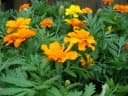
Tagetes erecta
Tagetes erecta
Safety & Hazards
None known
Cultivation Details
Tagetes erecta is mainly native to the subtropical zone of Mexico and Guatemala, though it has spread through cultivation is is naturalized from the temperate zone to the tropics. Although not very frost resistant, it can be grown as a tender annual in temperate areas, sowing the seed in a greenhouse in the spring and planting out after the last expected frosts. Requires a well-drained moderately fertile soil in a sunny position[1]. Grows well in heavy clay soils and in sandy soils[2]. Flowering starts about 3 months after planting and continues for several months[3]. The flowers are very attractive to butterflies[4]. Removing dead flowers before the seed is formed will extend the flowering season[2]. The flowers are often sold in local markets in Nepal and used as an offering to the Gods[5]. A number of named forms have been developed for their ornamental value[6]. The cultivar 'Yellow Climax' has mild flavoured edible flowers that can be used as colourful garnishes[6]. All parts of the plant emit an unpleasant smell similar to that of stale urine when they are bruised[7]. Plants are prone to attacks by slugs, snails and botrytis[2].
Propagation
Seed - sow early spring in a greenhouse. Only just cover the seed. Germination usually takes place within 2 weeks. When they are large enough to handle, prick the seedlings out into individual pots and plant them out after the last expected frosts. Cite as: Temperate Plants Database, Ken Fern. temperate.theferns.info. 2026-02-21. <temperate.theferns.info/plant/Tagetes+erecta>
Pollinators
Insects
References
- [1]The New RHS Dictionary of Gardening. 1992. — Huxley. A. · MacMillan Press · 1992 · ISBN 0-333-47494-5 ↩︎Excellent and very comprehensive, though it contains a number of silly mistakes. Readable yet also very detailed.
- [2]The RHS Gardener's Encyclopedia of Plants and Flowers — Brickell. C. · Dorling Kindersley Publishers Ltd. · 1990 · ISBN 0-86318-386-7 ↩︎Excellent range of photographs, some cultivation details but very little information on plant uses.
- [3]Protabase - Plant Resources of Tropical Africa. — http://www.prota.org ↩︎An excellent on-line database with detailed information on over 3,200 species of useful plants of Africa.
- [4]Butterflies and Moths in Britain and Europe. — Carter D. · Pan · 1982 · ISBN 0-330-26642-x ↩︎An excellent book on Lepidoptera, it also lists their favourite food plants.
- [5]Plants and People of Nepal — Manandhar. N. P. · Timber Press. Oregon. · 2002 · ISBN 0-88192-527-6 ↩︎Excellent book, covering over 1,500 species of useful plants from Nepal together with information on the geography and peoples of Nepal. Good descriptions of the plants with terse notes on their uses.
- [6]Cornucopia - A Source Book of Edible Plants. — Facciola. S. · Kampong Publications · 1990 · ISBN 0-9628087-0-9 ↩︎Excellent. Contains a very wide range of conventional and unconventional food plants (including tropical) and where they can be obtained (mainly N. American nurseries but also research institutes and a lot of other nurseries from around the world.
- [7]Scented Flora of the World. — Genders. R. · Robert Hale. London. · 1994 · ISBN 0-7090-5440-8 ↩︎An excellent, comprehensive book on scented plants giving a few other plant uses and brief cultivation details. There are no illustrations.
- [8]Flora of Guatemala — Standley P.C. & J. A. Steyermark · 1946 - 1976 · http://www.archive.org/ ↩︎A superb reference, though somewhat dated. Gives lots of plant uses as well as information on plant habit and habitat. The entire flora (13 volumes) can now be downloaded from http://www.archive.org/
- [9]Tropical Ornamentals; A Guide — Whistler. W. Arthur. · Timber Press Inc. Oregon. · 2000 · ISBN 0-88192-448-2 ↩︎An excellent little guide to some of the more commonly cultivated ornamental plants of the Tropics, often giving some information on the plants other uses.
- [10]Meet Flora Mexicana. — Pesman. M. W. · Dale S. King. Arizona. · 1962 · ISBN - ↩︎Very readable flora but rather lacking botanically. A few notes on useful plants.
- [11]Plants for Human Consumption. — Kunkel. G. · Koeltz Scientific Books · 1984 · ISBN 3874292169 ↩︎An excellent book for the dedicated. A comprehensive listing of Latin names with a brief list of edible parts.
- [12]A Dictionary of Plants Used by Man. — Usher. G. · Constable · 1974 · ISBN 0094579202 ↩︎Forget the sexist title, this is one of the best books on the subject. Lists a very extensive range of useful plants from around the world with very brief details of the uses. Not for the casual reader.
- [13]Encyclopaedia of Herbs and their Uses. — Bown. D. · Dorling Kindersley, London. · 1995 · ISBN 0-7513-020-31 ↩︎A very well presented and informative book on herbs from around the globe. Plenty in it for both the casual reader and the serious student. Just one main quibble is the silly way of having two separate entries for each plant.
- [14]Medicinal Plants of China — Duke. J. A. and Ayensu. E. S. · Reference Publications, Inc. · 1985 · ISBN 0-917256-20-4 ↩︎Details of over 1,200 medicinal plants of China and brief details of their uses. Often includes an analysis, or at least a list of constituents. Heavy going if you are not into the subject.
- [15]Native American Ethnobotany — Moerman. D. · Timber Press. Oregon. · 1998 · ISBN 0-88192-453-9 ↩︎Very comprehensive but terse guide to the native uses of plants. Excellent bibliography, fully referenced to each plant, giving a pathway to further information. Not for the casual reader.
- [16]A Weavers Garden — Buchanan. R. · McGraw-Hill Contemporary · 1987 · ISBN 0934026289 ↩︎Covers all aspects of growing your own clothes, from fibre plants to dyes.