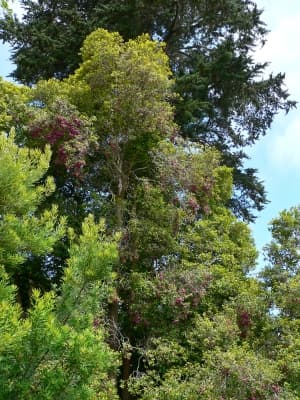
Syzygium smithii
Syzygium smithii
Safety & Hazards
None known
Cultivation Details
A plant of the subtropics to the tropics, where it is found at elevations up to 1,200 metres. It grows best in areas where annual daytime temperatures are within the range 18 - 28°c, but can tolerate 8 - 36°c[1]. It can be killed by temperatures of -5°c or lower, though new growth can be killed at -1°c[1]. It prefers a mean annual rainfall in the range 1,000 - 1,700mm, but tolerates 700 - 2,000mm[1]. Older plants grow well in a sunny position and in dappled shade, though younger plants need some protection from strong sunlight[2, 1]. Succeeds in most soils if they are well-drained[2, 1]. Prefers a pH in the range 5 - 6, tolerating 4.5 - 6.5[1]. Established plants are fairly drought tolerant, though will often show signs of stress[3]. Plants are often found growing along the sides of rivers, where they are able to withstand seasonal flooding and strong currents[4]. Young plants are rather slow-growing and spindly, but the growth eventually becomes very dense[4]. The plant responds well to pruning[3], and to coppicing[5]. Ripe fruits can remain hanging on the plant for several months[4].
Propagation
Seed - it has a short viability and so should be sown as soon as it is ripe[2]. Germination can be slow and erratic[3]. Fresh, unpeeled seeds germinate quickly and reliably[4]. Cuttings of firm, current season's growth[3]. Fairly easy to root[4]. Cite as: Tropical Plants Database, Ken Fern. tropical.theferns.info. 2026-02-20. <tropical.theferns.info/viewtropical.php?id=Syzygium+smithii>
Pollinators
Bees, Insects
References
- [1]Ecocrop — http://ecocrop.fao.org/ecocrop/srv/en/home ↩︎Basic information on a wide range of useful plants, plus details of environmental needs where available.
- [2]Trade Winds Fruit — http://www.tradewindsfruit.com/index.htm ↩︎The on-line catalogue of a company selling seeds. Gives descriptions, photos and uses of a very wide range of fruit and other food-producing plants plus ornamentals.
- [3]Australian Native Plants Society — http://anpsa.org.au/index.html ↩︎A series of fact sheets on Australian plants. Good photographs, brief description and information on uses, habitat, range, cultivation etc.
- [4]Australian Rainforest Plants Volumes 1 - 6 — Nicholson N. & H. · Terania Rainforest Publishing; New South Wales. · 2007 · ISBN 9-78095894-3628 ↩︎Beautiful set of booklets with a terse description of over 600 species and their habitat, often including some of their uses and notes on their cultivation, plus at least one, excellent photograph.
- [5]Australian Tropical Rainforest Plants — http://www.anbg.gov.au/cpbr/cd-keys/rfk/index.html ↩︎An online resource giving botanical information, and a little bit about plant usage, for over 2,700 species of plants found in the Australian rainforest.
- [PFAF]Plants for a Future — pfaf.org ↩︎