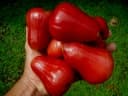
Syzygium samarangense
Syzygium samarangense
Safety & Hazards
None known
Cultivation Details
A plant of the moist, lowland tropics, where it is found at elevations up to 1,300 metres. It grows best in areas where annual daytime temperatures are within the range 23 - 28°c, but can tolerate 16 - 33°c[1]. It can be killed by temperatures of 0°c or lower[1]. It prefers a mean annual rainfall in the range 1,500 - 2,300mm, but tolerates 1,200 - 3,000mm[1]. Although it is not drought-tolerant, the plant grows best in areas with a fairly long dry season[2]. Prefers a sunny position but also succeeds in light shade[1]. Succeeds in a variety of soils, preferably well-drained[3, 1]. The plant requires a reliable water supply and is often planted along streams or ponds[2]. Prefers a pH in the range 6 - 7.5, tolerating 5 - 8[1]. Seedling plants commence fruiting when about 5 - 6 years old[3]. There are definite flowering seasons, often two, sometimes three in a year, but the timing varies from year to year[2]. A heavy-cropping tree, when grown on good soil a five-year-old plant may yield 700 fruits[2, 4]. There is at least one named variety[5]. There are some forms that are seedless[3].
Propagation
Seed - needs to be sown fresh from the fruit because it has a limited viability[6]. Give shade to the seedlings when young[6]. Air layering. Cite as: Tropical Plants Database, Ken Fern. tropical.theferns.info. 2026-02-20. <tropical.theferns.info/viewtropical.php?id=Syzygium+samarangense>
Pollinators
Bees
References
- [1]Ecocrop — http://ecocrop.fao.org/ecocrop/srv/en/home ↩︎Basic information on a wide range of useful plants, plus details of environmental needs where available.
- [2]World Agroforesty Centre — http://www.worldagroforestry.org/ ↩︎An excellent online database of a huge range of trees giving very good information on each plant - its uses, ecology, identity, propagation, pests etc.
- [3]Perennial Edible Fruits of the Tropics : an Inventory — Martin, F. W.; Campbell, C. W.; Rubertbe, R. M. · U.S. Dept. of Agriculture, Agricultural Research Service · 1987 ↩︎A booklet giving terse details of almost 300 species of edible fruits, plus regional lists of Botanical and Common names for over 2,500 less well-known edible fruits of the tropics.
- [4]Fruits of Warm Climates — Morton. J. · Florida Flair books, Florida. · 1987 · ISBN 0961018410 ↩︎A very well written guide to about 125 species.
- [5]Cornucopia II — Facciola. S. · Kampong Publications, California. · 1998 · ISBN 0-9628087-2-5 ↩︎The second edition of an excellent guide to the edible uses of plants, though it does not give any details of cultivation etc.
- [6]Under-Utilized Tropical Fruits of Thailand. RAP — Suranant Subhadrabandhu · F. A. O., The United Nations, Bangkok. · 2001 · http://www.fao.org/3/a-ab777e.pdf ↩︎A detailed report on 35 fruit species that could have potential for increased production in Thailand. The report can be downloadd as a PDF from the internet.
- [7]Trade Winds Fruit — http://www.tradewindsfruit.com/index.htm ↩︎The on-line catalogue of a company selling seeds. Gives descriptions, photos and uses of a very wide range of fruit and other food-producing plants plus ornamentals.
- [8]Journal of the Arnold Arboretum Vol. 54 — Harvard University; Massachusets · 1973 · http://www.biodiversitylibrary.org · ISBN 0004-2625 ↩︎A botanical magazine, it includes a provisional key and enumeration of the genus Syzygium in New Guinea. It can be downloaded from the Internet.
- [9]Tropical Food Gardens — Norrington. L. · Bloomings Books (Melbourne) · 2001 · ISBN 1-876473-41-x ↩︎Excellent little book giving some basic information on a range of plants.
- [10]The New RHS Dictionary of Gardening. 1992. — Huxley. A. · MacMillan Press · 1992 · ISBN 0-333-47494-5 ↩︎Excellent and very comprehensive, though it contains a number of silly mistakes. Readable yet also very detailed.
- [11]Tropix 7 — CIRAD · http://tropix.cirad.fr/en ↩︎An on-line guide to the timbers of 245 species of trees.